Unlock the White House Watch newsletter for free
Your guide to what Trump’s second term means for Washington, business and the world
The writer is an FT contributing editor, visiting scholar at the Hoover Institution and author of a forthcoming book on globalisation
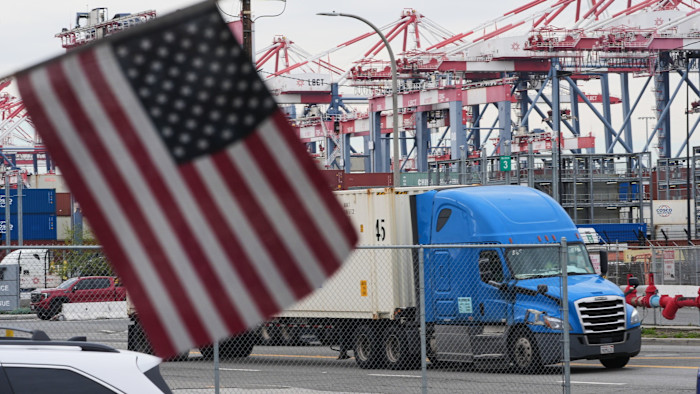
If you have followed the news in 2026 you might think that the global economic conflict is peaking. Last week’s Supreme Court judgment suggests that US President Donald Trump has reached the constitutional limits of his tariff war. Judged on its own terms it has been ineffective, with most duties passed through to US businesses or voters. As a result the policy is unpopular, with 64 per cent of Americans disapproving of it. Because most countries have resisted a 1930s-style retaliatory cycle, if Trump, or his successor, back off, the tariff war will quickly de-escalate. Yet when it comes to economic nationalism, you ain’t seen nothing yet.
Tariffs get lots of attention, and not just because they obsess Trump. The activity affected is huge and simple to count: in 2024 global flows of imports and exports of goods were $49tn, equivalent to 45 per cent of global GDP. The mechanism of intervention is easy to understand, a tax on physical goods crossing borders. The direct costs are quantifiable. Trump’s tariffs raised the equivalent of 1 per cent of US GDP in 2025. It is fairly clear who makes decisions. In America, the executive or Congress do. In China, Xi Jinping does. And there is a global consensus about their efficacy, which is that at best they are a wash, with the cash raised by the state mostly paid by consumers. At worst they kill efficiency and confidence.
The trouble is that goods trades and tariffs are only the most visible part of globalisation and economic nationalism. The other part is harder to count but probably bigger. Global cross-border inflows and outflows of services, intellectual capital, data services, investment and other kinds of receipts and payments were $48tn in 2024. If you include the local sales of multinationals’ subsidiaries abroad, the total rises to over $60tn.
Even this is an undercount. Some flows are far more important than others. The world’s cloud hyperscalers make less revenue than its clothing exporters but can bring the planet to a standstill. Cross-border payments networks are a mid-sized industry by revenue but affect how capital is allocated. A disproportionate share of global stock markets’ value rests on the high profitability of superstar companies that control the flows of intellectual capital.
The mechanisms that governments are now using to influence this giant, second category of global activity are far harder to track than tariffs. They involve a departure from the principle that companies should be treated neutrally regardless of nationality. This happens through a maze of industrial policies, sanctions, investment controls, regulatory bias, heightened patriotism and other social norms. The direct costs are impossible to quantify. Decision making is diffuse, involving government agencies, regulators and private firms. As a result, even if you wanted to press rewind, it would be hard to do so. And most governments do not want to wind it back. They are embracing “economic statecraft” because they believe it can enhance national security in a dangerous world, placate some voters and boost development.
Thus as the tariff threat peaks, economic nationalism is still cranking up. The evidence is everywhere. Countries are building substitutes for the financial, tech and defence networks they were dangerously dependent on. Europe is planning a digital currency. Rheinmetall, Germany’s main defence company, projects its revenues will be five times as big in 2030. India has just announced $210bn of private investment in “compute” capacity that is physically located inside its borders.
Most multinationals and investment houses are weighing how to adapt to this change. For companies, it means reorganising external counterparties and internal structures to capture the huge profits while avoiding the huge costs. For investors, the shift points to a divergence of asset prices, interest rates and risk premia, disrupting the convergence mega-trade that has ruled global finance for 30 years.
In the US, attention is slowly but inexorably turning to the 2028 election and what happens after Trump. Many people hope for a restoration of centrist politics, a reaffirmation of rule of law and the end of hyperactive tariffs. Perhaps they will get it. Yet an unacknowledged truth is that whoever comes next, there will be a large degree of continuity, especially on differentiating between businesses based on their nationality. The new norm, in America and elsewhere, is that foreign policy and capitalists are expected to serve the country first, and the world second, if at all. That is why, even if tariffs peak, the new age of economic nationalism is just beginning.
Source link