Unlock the Editor’s Digest for free
Roula Khalaf, Editor of the FT, selects her favourite stories in this weekly newsletter.
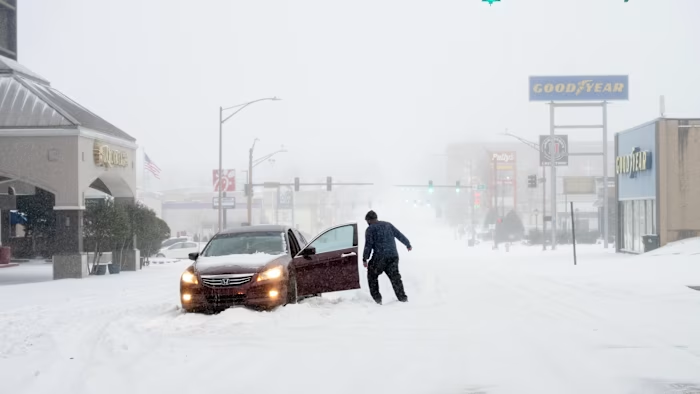
A severe winter storm ripping across the south and east of the US and parts of Canada has caused mass power outages and the cancellation of thousands of flights.
More than 820,000 people across the US were without power on Monday at 7am eastern time, according to tracking website Poweroutage.com. The hardest hit were the states of Mississippi, Tennessee and Louisiana, with power in Texas gradually being restored after a mass outage.
At least 22 people have been reported killed in the US due to the storm.
Nearly 18,000 flights from Saturday to Monday were cancelled across the US, according to flight-tracking site FlightAware, leaving passengers stranded at airports across the US.
Airlines cut more than 11,130 flights on Sunday alone. Sunday’s cancellations were the highest number since the coronavirus pandemic, according to aviation consultancy Cirium.
Major carriers such as American Airlines cut 46 per cent of their Sunday schedule, while JetBlue has scrapped as much as 70 per cent. Some airports have almost ground to a halt, with more than 90 per cent of flights from LaGuardia, Reagan National and Philadelphia cancelled on Sunday.
According to FlightAware, almost two-thirds of all flights — 619 in total — were cancelled at Toronto’s Pearson airport in the 24 hours starting Sunday morning.
Airport officials on Monday urged passengers to check with their airlines before setting off as flights to and from eastern Canada and parts of the US were still affected by the storm.
Meteorologists say warm Arctic waters and cold continental land combine to stretch the polar vortex farther south from its origins in the Arctic.
North of the border, Environment and Climate Change Canada agency issued rare orange and yellow alerts as the storm paralysed the Ontario and Quebec provinces over the weekend. Toronto’s city centre was buried under 56cm of snow, and the agency reported near-zero visibility and dangerous driving conditions, forcing widespread school closures on Monday.
The city has had 88.2cm of snow this month, “officially making January 2026 the snowiest month since records began in 1937”, said Environment Canada.
As Winter Storm Fern travels eastward, power companies are braced for snow, freezing rain and sleet to hit the grid system, with helicopters and line construction crews being dispatched to identify damage and carry out swift repairs.
Georgia Power urged its customers to prepare for two- to three-day outages, while Dominion Energy in Virginia warned that icy conditions could knock out power in the region for days.
Governors of Virginia, North Carolina, South Carolina and Georgia declared a state of emergency. On Thursday energy secretary Chris Wright ordered grid operators to make more than 35 gigawatts of backup generation available to prevent blackouts.
Power outages cost the US $44bn last year, according to the Department of Energy’s National Laboratories.

Fern is drawing comparisons to Winter Storm Uri, which led to mass blackouts and loss of life across Texas in 2021. Temperatures are expected to drop to the low teens and single digits Fahrenheit, with wind-chill factors of minus 10F to 0F (minus 23C to minus 17C).
“The same risk of power outages due to lower natural gas production still applies, as natural gas wells can freeze in temperatures below freezing,” said Mark Callahan, director of Americas natural gas pricing at S&P Global Energy. “However, conditions for this storm are not as bad, and work has been done since 2021 to winterise the grid for such events.”
While Texas is better prepared due to grid modernisation efforts and the rise of home generators, “the buffers in the system are much more constrained” by rising power demand from data centres and electrification of household appliances, said Didi Caldwell, chief executive of Global Location Strategies.
PJM, the grid operator that serves more than 67mn people in the north-east and Midwest, said temperatures could reach single digits Fahrenheit across the region and dip below zero in the west.
Natural gas was trading at elevated levels on Monday, with prices at about $51 per million British thermal units in New England, $61 in New York and $34 in the Midwest, according to data from the Energy Information Administration.
However, these prices were “much lower than the $1,000 prices we saw during Uri”, said Mark Callahan, director of Americas natural gas pricing at S&P Global Energy.
Retailers Amazon and DoorDash said they would balance deliveries of consumer staples while prioritising the safety of their workers. By Monday morning more than 300 Walmarts across the country were closed.
Additional reporting by Gregory Meyer
Climate Capital

Where climate change meets business, markets and politics. Explore the FT’s coverage here.
Are you curious about the FT’s environmental sustainability commitments? Find out more about our science-based targets here
Source link