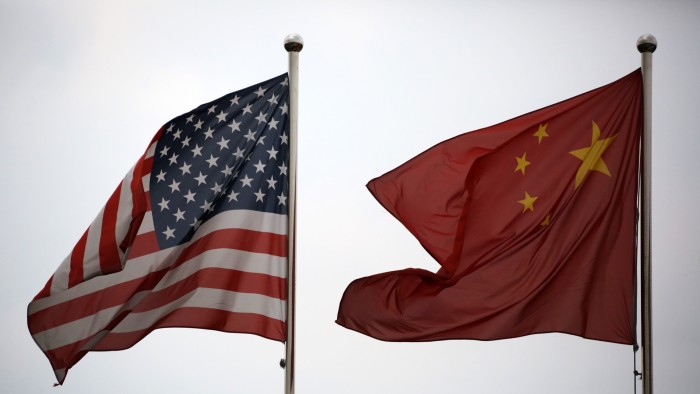
For a moment on Friday the trade war correspondents were getting out their flak jackets and preparing for the tariff artillery bombardments to begin. In response to Beijing’s announcement the day before about rare earth export controls, US President Donald Trump (or someone in his name) fired off a rambling Truth Social post threatening 100 per cent extra tariffs on China and a ban on critical software exports from November 1. He also contemplated pulling out of a meeting in late October with Chinese President Xi Jinping. Even the somnolent equity markets dropped sharply. Is it time to worry like it’s April 2025?
Today’s extended newsletter looks at how Trump had softened his tone by Sunday and where this issue is likely to go. For light relief, we also check in on the perennial trouble spots of Argentina and global steel trade. Charted Waters, where we look at the data behind world trade, is on equity prices.
Get in touch. Email me at alan.beattie@ft.com
I can’t get no escalation
For a soi-disant artist of the deal, Trump is pretty bad at game theory. Beijing’s export control announcement on Thursday was clearly an exercise in teeth-baring ahead of the Xi-Trump meeting, following its recent boycott of US soyabean exports. Trump losing his rag showed he didn’t understand what was happening.
By Sunday, the US president was sounding much more emollient and it was pretty clear who had the upper hand. Trump’s trade representative, Jamieson Greer, admitted that Beijing “deferred” when Washington called to ask what was going on. For its part, China didn’t yield at all, saying on Sunday it was prepared for a trade war if necessary and accusing the US of a double standard for unilaterally imposing its own controls.
At this point I pause to tap two related signs. One is my own, analogising the US-China rivalry to the scene in The Princess Bride where the villain (in this case Trump) extols his own genius shortly before dying from drinking poison (trade war), while the hero (Xi) survives, having spent years building resistance to the toxin (building a rare earths monopoly). The Peterson Institute’s Adam Posen makes a similar argument, though characteristically more cerebral, where he describes China’s “escalation dominance” through its key technology advantages.
I’m not saying the Trump Always Chickens Out (Taco) trade is back, but I suspect the US president will get enough warnings from people around him neither to ratchet up tensions before the meeting nor to cancel it. His unwarranted confidence in his dealmaking will also ensure it goes ahead.
Here’s the US’s problem, though. Xi can promise what he likes at the meeting: resuming the procurement of American soyabeans, pretending to buy more (as he did in Trump’s first term), presenting Trump with a smoking monkey, or whatever. But unless the White House and its dwindling number of allies develop their own rare earth supply chains, the US will always be vulnerable.
ET, phone home
OK so technically Steven Spielberg’s alien was extraterrestrial, not extraterritorial, but I’m going with the ET thing. The Chinese rare earths developments are not just extraordinary, but extraterritorially so.
Beijing’s announcement showed the vast leverage it has via its monopoly on rare earths extraction and refining. The controls affect China-produced minerals anywhere in the world, even in tiny quantities and for products sold between countries outside China. As the Financial Times story linked above notes, even US AI chips made in a US factory sent to a US AI laboratory would need China’s permission. Eek.
It’s worse than the unbelievable rip-off whereby governments must pay China to be allowed to keep a panda, even if they’ve bred it themselves. And that’s saying something. Essentially it’s a Chinese version of the US Foreign Direct Product Rule, a legal authority from 1959 that former president Joe Biden dusted off and vastly expanded to control the use of American chip technology by any company anywhere in the world.
A quick recap: China has periodically imposed rather weak export controls on rare earths for decades. Until now, they were undermined by smuggling and production elsewhere. The measures announced in April were much more serious, involving so-called heavy rare earths, the ones skulking down the bottom of the periodic table. No other country really produces them, and in China they’re made by state-owned companies whose sales can be strictly monitored.
The restrictions have caused intense uncertainty and howls of pain from European and US companies. It’s not clear whether delays granting end-user export licences since then reflected genuine bureaucratic inertia or tactical displays of power.
Two can play at that game, as we saw from Biden’s attempt to restrict Chinese access to advanced chips. But China has already shown it can catch up pretty quickly; its industrial, military and intelligence capabilities have continued to develop despite US restrictions. And Trump has shown he’s no good at playing his cards, allowing chipmakers Nvidia and AMD to resume exports to China in return for a 15 per cent tax on the proceeds.
China’s exports to the US have been severely limited by Trump’s tariffs. But its exports elsewhere have strengthened. The US just isn’t a big enough consumer to bring China to heel.
The only way China’s rare earths blackmail doesn’t work is if it turns out it doesn’t have the capacity to monitor global supply chains to enforce the bans effectively, allowing companies to shuffle products around without being seen. But if you’re a manufacturer with a presence in China, is that a risk you’re going to take?
The usual suspects
Back with more familiar areas of dysfunction, if you want an intractable shambles you can always rely on global steel trade and Argentina. Never were a commodity and country more bent on screwing up the global trading system and destroying the norms of financial governance.
Steel first. Brussels last week pulled off the kind of manoeuvre only the EU could do with such panache — a huge protectionist intervention of cutting steel quotas and raising non-quota tariffs while blithely claiming the move is within World Trade Organization rules. As Sam Lowe points out here, this might end up with the EU belatedly being bullied into the club to keep out Chinese steel, something that the Biden administration tried and failed to do.
Now, it’s worrying if this is evidence of the long-feared trade deflection, where waves of US-bound Chinese exports bounce off the Trump tariff wall and slosh around the world trading system, driving down prices and causing protectionist consternation all over.
But as Simon Evenett of the Global Trade Alert project notes, steel is already almost completely blocked from the US market after decades of antidumping and anti-subsidy duties. So it’s unlikely that Trump tariffs have much to do with the global glut. (China is probably just increasing production to keep its growth rate up.) So let’s not read too much into the EU’s actions for the moment. I mean, really. It’s just steel. It’s always steel.
Now Argentina. The Trump administration, always liable to place ideology above simple common sense, has put some substance behind its promise to help Argentina, directly supporting the peso in currency markets last week with money from the Exchange Stabilization Fund. (The ESF has been used for other bailouts in the past, notably Mexico in 1994.)
This is quite the move. US Treasury secretary Scott Bessent called it a “currency swap framework”. But as former US officials Heidi and Doug Rediker pointed out for Alphaville, the term “swap line” is reserved for central banks providing liquidity to counterparts. This, on the other hand, is a discretionary taxpayer-backed loan made for political reasons.
So does this presage a new era of geopolitically-oriented lending? Possibly. But the US’s willingness to put taxpayers’ money at risk has limits, and even the IMF’s desire to keep on good terms with the Trump administration won’t give the president unlimited multilateral funds to bail out friends. Pressure on the US Federal Reserve to issue swap lines to geopolitical allies really would be a big deal, but we aren’t there yet. So far it’s, you know, just Argentina. It’s always Argentina.
Charted waters
As noted above, Trump’s tariff threats caused the sharpest one-day sell-off in the S&P 500 since April.
Trade links
-
Ignacio García Bercero, former senior European Commission trade official, argues that the EU should soften its new quota and tariff restrictions on steel imports.
-
Pharma company AstraZeneca has struck a deal with Trump to cut drug prices in return for a reprieve on tariffs.
-
Two weeks ago I was sceptical that China’s largely symbolic offer to give up its “special and differential” privileges at the WTO would impress the US. I was right: the Trump administration last week told a WTO meeting that it was essentially meaningless.
-
Another one for the “global food crisis that got the globalisation worrywarts out in force but actually turned out to be OK” file: after climbing rapidly higher over the past couple of years, cocoa prices have dropped to a 20-month low. Amazing to relate, this partly reflects supply going up as growers react to higher prices.
-
England has suffered its second-worst harvest on record this year, while global wheat output is likely to hit a new high. Just as well we have international trade, then. Shout-out to old Bob Peel for his help on this one.
Trade Secrets is edited by Harvey Nriapia
Source link