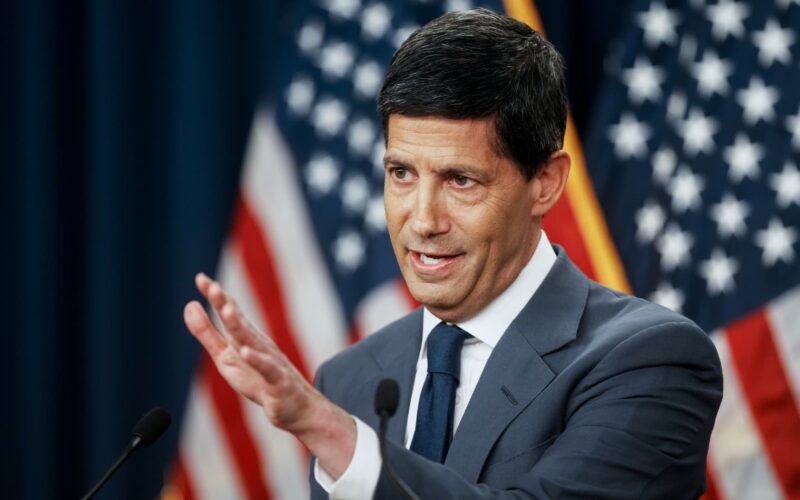
Kevin Warsh, chairman of the US Federal Reserve, during a news conference following a Federal Open Market Committee (FOMC) meeting in Washington, DC, US, on Wednesday, Oct. 28, 2026.
Al Drago | Bloomberg | Getty Images
The Federal Reserve voted Wednesday to hold its benchmark interest rate steady. At the press conference that followed, Fed Chairman Kevin Warsh disclosed some of his thinking about where the U.S. economy stands, and how that affects monetary policy. But for Fed wonks, the big news may have been Warsh’s disclosure of some procedural changes ahead.
Here are five key takeaways:
- No surprises: Markets had been widely expecting the Fed to hold, and it did just that. In explaining its decision, the Federal Open Market Committee emphasized a patient approach, saying, “The accumulation of more information will help the Committee determine the policy stance appropriate to ensure a timely return of inflation to the Committee’s 2 percent goal.”
- Well, one surprise: If there was one eyebrow-raising moment from the afternoon, it was Warsh’s disclosure of changes in how the FOMC will meet. In 2027, the committee will still meet eight times, but one of the meetings will not entail a vote on interest rates, or include a post-meeting statement. The “strategy” meetings will increase to two the next year, leaving just six opportunities to adjust rates — outside of emergency meetings.
- OK, two surprises: The FOMC vote to hold policy where it stands was widely expected. Dissent from multiple members also came as no shock. But one of the “no” votes coming from Governor Lisa Cook was a stunner. Governors rarely dissent from rate votes, and Cook hasn’t done so at all since taking her seat in 2022. Cleveland Fed President Beth Hammack also opposed the decision. Both likely will provide statements explaining their votes before the end of the week.
- The AI impact: Warsh took the opportunity to talk about the impact artificial intelligence is having on economic growth, essentially saying that it was just one of several factors driving an expansion that he said was running strong.
- More musical chairs: The September meeting featured a shortened post-meeting news conference — cut from the usual 45 minutes or so down to half an hour, about the time of Wednesday’s event. Moreover, reporters have been limited to a single question, a switch from prior practices when media members would take a two-for-one approach. Finally, Warsh has changed the seating in the room, going from a largely arbitrary approach — with representatives of larger outfits up front — to alphabetical order last month. This month featured reverse alphabetical order, keeping the bearers of the microphone on their toes.
What they’re saying:
“The Fed is leaning into patience. It seems they prefer to wait for more information on the appropriate level of rates, as uncertainty reigns supreme in light of recent geopolitical developments.” —Phil Camporeale, chief investment strategist, JPMorgan Wealth Management.
“The Fed has time on its side … But the direction of travel remains clear. The Fed is still taking back some of last year’s rate cuts, and the two dissents underline that tightening bias. We expect a hike in December and another in early 2027.” — Seema Shah, chief global strategist, Principal Asset Management.
“We hesitate to characterize his communication as particularly dovish or hawkish … The bottom line is that the Fed policy reaction is not a black-and-white, binary thing … The market has adjusted to Warsh’s communication style, but there might be a ways to go before they are fully on the same page.” — Thomas Simons, chief U.S. economist, Jefferies.
Source link