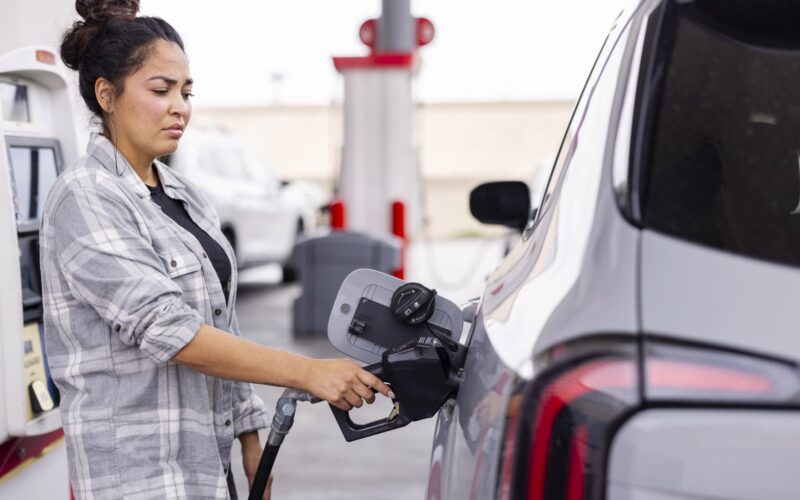
Laura Olivas | Moment | Getty Images
A late-summer surge in gasoline prices means drivers are paying more at the pump than they ever have on Labor Day.
And, since the Labor Day holiday weekend is one of the busiest travel weekends of the year, according to rental car company Hertz, that means road trips may be more expensive than usual.
The national average for a gallon of regular unleaded gas was $4.15 on Monday, a record high for for the holiday, according to AAA.
The price has never been above $4 per gallon on Labor Day, according to AAA. The previous record was $3.82, reached on Sept. 3, 2012.
And, although the per-gallon price is down from the 2026 high of $4.56 in May, prices are still about 30% higher than the average $3.20 drivers were paying a year ago, according to AAA.
“While gasoline demand typically declines after the summer driving season — often leading to lower prices — this year’s elevated crude oil costs have offset that seasonal trend,” said Brittany Moye, spokesperson for AAA.
The price of diesel, meanwhile, also hit a record heading into the long holiday weekend. It cost $5.90 per gallon on Monday, compared with $3.71 a year ago, according to AAA.
Global oil supply remains constrained
Vessels near the Strait of Hormuz, as seen from Musandam, Oman, Aug. 31, 2026.
Stringer | Reuters
West Texas Intermediate crude oil futures — a benchmark for U.S. oil prices — were trading at roughly $92 per barrel as of 9:30 a.m. ET on Monday, compared with about $67 before the Iran War started Feb. 28. Similarly, Brent crude oil futures, an international benchmark, were trading at about $97 per barrel on Monday, up from roughly $72 pre-war.
Oil prices have been volatile throughout the conflict as oil tankers have been thwarted from transiting the Strait of Hormuz, crimping global supply.
Crude oil is the main input for gasoline and generally the largest component of the retail price.
An estimated 4.9 million barrels of crude oil and petroleum liquids were transported daily through the Strait in the second quarter of the year, a sharp drop from the average of 21.6 million barrels per day in the last quarter of 2025, before the conflict in Iran began, according to the U.S. Energy Information Administration.
Refineries also have been taken offline due to both the Iran War and the Russia-Ukraine War, which is affecting the supply of gasoline.
“We still have a supply disruption in the Middle East at the same time refineries in both the Middle East and Russia have been damaged due to conflicts in those regions, which reduces supply that reaches the market,” said Andy Lipow, president of Lipow Oil Associates in Houston, a consulting firm that specializes in refinery operations.
U.S. gasoline inventories were 6% below average for the week ending Aug. 28, according to the EIA.
Winter-blend gas could help prices at the pump
However, there may be a mitigating factor in higher gas prices arriving soon, Lipow said.
“The good news for consumers is that the industry transitions [in September] to winter-grade gas, which will provide some measure of relief at the pump,” Lipow said.
Winter gasoline is generally cheaper due to the lower cost of producing it, according to the EIA. Summer gas is formulated with a more expensive blend and generally stops being produced on Sept. 15.
This year, in an effort to boost supply and bring down prices, the Environmental Protection Agency announced Aug. 20 that winter-blend gas could be sold beginning Sept. 1, effectively ending the summer-blend requirements early.
However, the global supply of oil remains a key factor in the trajectory of gasoline prices, experts said.
“The market is waiting to see whether the U.S. and Iran come to some [agreement] where the Strait of Hurmuz is open to all traffic,” Lipow said.
Source link