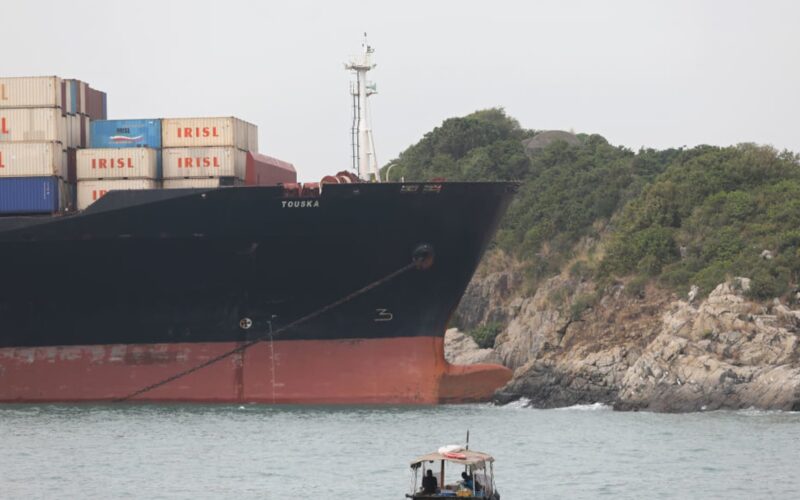
File photo: Cargo ship Touska, which was fired upon and disabled by the U.S. Navy, before being sized by Marines. Trump said Sunday that the USS Spruance intercepted the Iranian ship, the Touska, and “gave them fair warning to stop.”
South China Morning Post | South China Morning Post | Getty Images
Fifty days into the U.S.-Israel war with Iran, tensions escalated again after clashes in the Gulf prolonged shipping disruptions and cast doubt on a fragile ceasefire set to expire this week.
On Friday, Iran declared the Strait of Hormuz fully open to commercial traffic, sending crude prices tumbling more than 10%. By Saturday, hopes for a fully opened artery quickly unraveled as Tehran reimposed closure of the chokepoint, after President Donald Trump refused to end the U.S. naval blockade of Iranian ports.
After a brief pickup in transit attempts on Saturday, shipping traffic in the Gulf stalled once again, with vessels coming under fire mid-passage and being forced to withdraw.
On Sunday, the U.S. Navy fired on and seized an Iranian container ship in the Gulf of Oman. Trump called Iran’s actions over the weekend a “total violation” of the truce and renewed threats to strike Iranian power plants and bridges if Tehran refuses a deal.
For markets, it was a reminder of the fragility of the two-week ceasefire, and a deal that could bring a lasting end to the war is still far from done.
U.S. stock futures fell while crude oil prices surged as the U.S. and Iran teetered on the brink of a renewed conflict. West Texas Intermediate futures jumped more than 6% to $89 per barrel shortly after midnight on Monday while and the international benchmark Brent climbed 5.6% to $95.50 a barrel.
“We had the most violent day in the strait on Saturday that we’ve had since the beginning of this crisis, and things don’t seem to be getting any better,” said Rory Johnston, founder of Commodity Context.
“While we keep getting these sell-offs and it keeps seeming like we’re about to finally get that, the football — Lucy pulls it away — and we’re back to where we started,” Johnston told CNBC’s “Squawk Box Asia” on Monday.
“The strait still isn’t flowing, and 13 million barrels a day of production remains shut-in. We’re losing it every single day this goes on,” said Johnston, who is also a lecturer at the University of Toronto’s Munk School of Global Affairs and Public Policy.
The best realistic outcome
Much will hinge on whether the U.S. and Iran will meet for a second round of peace negotiations in Pakistan later this week, as the ceasefire is set to expire on Tuesday.
Trump said that the American and Iranian negotiators would resume talks in Islamabad on Monday. Iran, however, has denied that it would participate in the meeting, citing what it called Washington’s “excessive demands, unrealistic expectations, constant shifts in stance” and the ongoing blockade as a breach of the ceasefire.
The first round of talks on Apr.12 between Vice President JD Vance and Iranian Foreign Minister Abbas Araghchi failed to yield an agreement. Washington reportedly proposed a 20-year pause on Iranian uranium enrichment, a request that Iranian leaders rejected, insisting on 5 years.
Until, and unless the U.S. negotiating team rids itself of the misconception that military victory equals strategic dominance, we’re not going to get to a solution.
Alan Eyre
Distinguished Diplomatic Fellow at the Middle East Institute
Underlying differences between Washington and Tehran run deeper than the current impasse, said Alan Eyre, a distinguished diplomatic fellow at the Middle East Institute and former member of the U.S. team that negotiated the 2015 Iran nuclear deal.
“The U.S. side has really not been focused on negotiation per se. What they’ve been waiting for is Iranian capitulation,” Eyre said. “Until and unless the U.S. negotiating team rids itself of the misconception that military victory equals strategic dominance, we’re not going to get to a solution.”
Eyre warns that the latest flashpoints risk taking the conflict a leg higher in the near term. “There’s an escalatory predisposition here where both sides could escalate and go back into a shooting war, which no one wants.”
While a productive round of negotiations in Islamabad remains a possibility, it is “unfortunately more likely to just go the other way — a resumption of hostilities,” Eyre added.
High-stake gamble
The economic costs of the conflict are mounting as the Strait of Hormuz — which normally carries roughly one-fifth of global oil supply — has been effectively closed for nearly two months.
“The crisis is one of lost time and lost production,” Johnston said, estimating supply disruptions of around 13 million barrels of crude, condensates, and natural gas liquids per day.
“That cumulative effect has already breached above half a billion barrels,” he said, warning that even an imminent deal announcement would not immediately unwind the damage.
Even if a deal is reached, experts warn that it could take months to claw back the supply lost over recent weeks of closures, keeping oil prices elevated for longer.
“If we actually got the strait open, we would probably see another $10 to $20 a barrel immediate rout because of the speculative hot money. But at the end of the day, we’d dump on day-one and then claw ourselves back higher — probably into the $80 and $90 — to reflect the [oil] scarcity that’s ongoing.”
Crude prices have surged over 30% since the war broke out, with Brent briefly topping $110 a barrel for the first time in roughly four years, according to LSEG data, before easing on hopes for a breakthrough.
More than 500 million barrels of crude and condensate have been knocked out of the global market — the largest energy supply disruption in modern history, according to Kpler data.
Despite the severity of the energy disruption, U.S. equity markets have remained largely resilient, as investors shrugged off the conflict as a blip that will be resolved relatively quickly.
Vishnu Varathan, head of macro research at Mizuho Bank, however, cautioned that the optimism may be premature. “We can’t get prematurely euphoric about any deal signed, because the lingering adverse effects mean we don’t get out of this quickly.”
The International Monetary Fund warned on Tuesday that global growth will inevitably take a hit even if the ceasefire holds, citing uncertainty around the Strait of Hormuz as a persistent drag, pushing up energy costs and inflation.
“It’s clear we’re not going back to the Goldilocks scenario,” said Brian Arcese, portfolio manager at Foord Asset Management, referring to a scenario of stable growth and low inflation. The longer the Strait remains closed, the greater the risk to the global economy, he said, although the actual extent of the damage can shift on “a daily and weekly basis.”
Source link