On Monday President Donald Trump said the war with Iran would end “very soon”. We do not know if these words were a reaction to market turmoil and oil prices moving above $100 per barrel or the situation on the ground in the Gulf. But financial markets got what they desired.
Is this an example of Trump always chickening out (Taco)? Probably. But Taco is an inefficient process. Markets have to tank before the policy reversal or soothing words. If you assume Taco in advance, it won’t come.
At the moment on Tuesday morning European time, oil and gas producers in the Gulf still cannot export through the Strait of Hormuz. From an economic standpoint, this is a pure supply shock. It is not the same as the post-pandemic Russian invasion of Ukraine, since that shock elevated demand alongside reduced energy supplies.
A pure supply shock, being itself a hit to global GDP, weakens the global economy. Other than that, the main effect of an energy shock is to redistribute money from energy consumers to producers.
The winners will be the producers that can still supply the market, which means the US, Russia and others will probably boost output. The losers will be consumers everywhere, including in the US, and energy-importing countries, particularly in Europe and Asia.
This forced redistribution will potentially be large and have serious economic effects depending on its scale, duration and the responses of companies, households and central banks. Since I clearly identified the Houthis’ threats to the Suez Canal two years ago as nothing to worry about, I have licence to say this is not a time to be complacent.
Duration of shock
In the list of concerns, the duration of the US and Israeli bombing campaign against Iran and the Islamic republic’s threats to shipping in the Strait of Hormuz are clearly the most pressing. If the current military action soon ends and tensions fade, the shock to supply will be much less serious.
Despite Trump’s words, the conflict shows few signs of an imminent end and fears in financial markets have risen. The spike in spot crude prices on Monday to more than $100 a barrel matters less than the upward march of the price for future deliveries of oil (shown in the chart below). The latter has now retreated, but only to its level on Friday last week.
The main conclusion here is that oil markets still expect the conflict and supply shock to be pretty shortlived, with the oil price predicted to fall back to $75 per barrel by the end of this year.
Futures market moves for wholesale European gas prices are a little more complicated. The extreme upward move in TTF futures gas prices, which had them high all through 2026 and early 2027, has eased. But markets are not generally reassured and futures prices next year and beyond are higher on Tuesday morning than they were on Monday. If this forward curve is correct, there will be a significant rise in heating bills across Europe in the coming year.

Scale of the energy shock
What everyone fears, especially in Europe, is a repeat of 2022, when the price increase of natural gas following Russia’s invasion of Ukraine far exceeded rises in global oil prices. At the time, with Russia playing politics with supplies, there were genuine fears of gas shortages among companies and households.
The chart below is a little arbitrary, as I have drawn the rise in European wholesale gas prices and Brent crude oil prices since the start of 2026 and compared them with the 2022 figures. If you are European, look away now — 2026 is repeating the 2022 playbook, with a doubling of wholesale prices since the start of the year. Meanwhile, the oil price rise is considerably smaller. Note that costs rose a lot higher in the late summer of 2022 as fears for the winter heating season escalated. This will be the key test this year.

There is no reason for 2026 to continue following the pattern of 2022, but I have drawn both years together to demonstrate scale. This supply shock is already proving to be large.
In fact, it is similar to a scenario the European Central Bank modelled in 2023 after Hamas attacked Israel. In that scenario, Eurozone growth was 0.7 per cent lower in the first year than previously forecast and inflation was nearly a percentage point higher. Compared with the latest ECB forecasts, that would leave the Eurozone in 2026 with little growth and inflation close to 3 per cent.
Resilience and vulnerabilities
It is important to think about what has improved since 2022. Europe has a much greater capacity for importing liquefied natural gas (LNG), has significantly cut gas consumption and has reorganised interconnectors to remove bottlenecks. US exports of LNG were 65 per cent higher in December 2025 than in December 2021, so the extreme vulnerability of four years ago should not reoccur.
With the 2025-26 winter heating season coming to an end, gas storage levels are low in Europe. But there is ample time to restore them, provided that Qatar’s LNG becomes available again soon. Even without it, Europe is more resilient — so a crisis on the scale of July and August 2022 is unlikely.

With greater resilience, it is important not to exaggerate the shock. But there are some vulnerabilities. The potential inflationary shock when oil and gas prices rise manifests not only in their direct heating and transport use cases, but as inputs for almost all food, goods and services. And households have lower tolerance to “transitory” inflation than in the post-Covid period.
Impact on inflation
Even though the impact of the war on European natural gas has so far exceeded the effect on crude oil, we would normally expect the initial inflationary pressure to be seen first and most dramatically in the US. Stateside, the low taxes on road fuels make them cheap. The downside is that prices at the pump move much more in lockstep with wholesale prices.
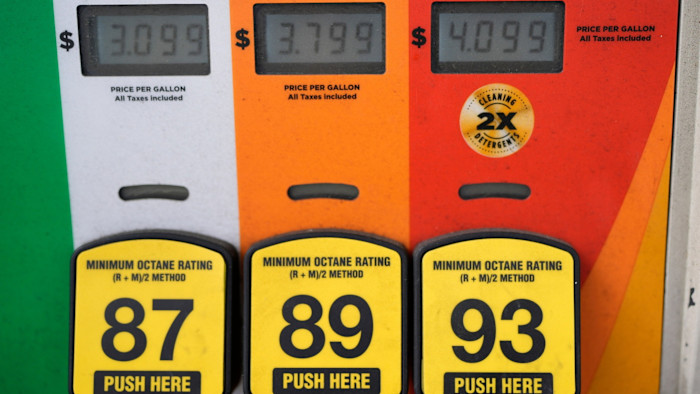
Over the past week US petrol prices have risen 16 per cent, with diesel up 24 per cent. Even though there have been complaints about UK fuel stations price-gouging, the increased cost of motoring in Britain has been extremely small by comparison. That is the benefit of high duties on petrol and diesel.
What is more surprising has been the large rise in German fuel prices in the past week, especially as price comparison between retailers is extremely easy.

Central bankers have watched these movements in global markets without pressing the panic button. Markets are volatile and the scale is large but the duration of this shock is only 11 days so far. Even those with a hawkish reputation have been restrained in delivering warnings about higher interest rates. One such example, ECB executive board member Isabel Schnabel, said that “monetary policy remains in a good place”.
I am sure central bankers will want to repeat similar holding statements at next week’s monetary policy meetings for the Federal Reserve, ECB, Bank of Japan and Bank of England. It really is just too early to be sure what the right policy response should be — especially with the energy price volatility of the past two days.
What I’ve been reading and watching
One last chart
This newsletter has attempted to scale the current Gulf crisis. That is a difficult task. One new formulation is to use the FT geopolitical mood index we devised at Monetary Policy Radar. It measures the tone of the FT’s coverage, weighted by the spatial proximity of all articles to geopolitics. The mood is bad.

Central Banks is edited by Harvey Nriapia
Source link