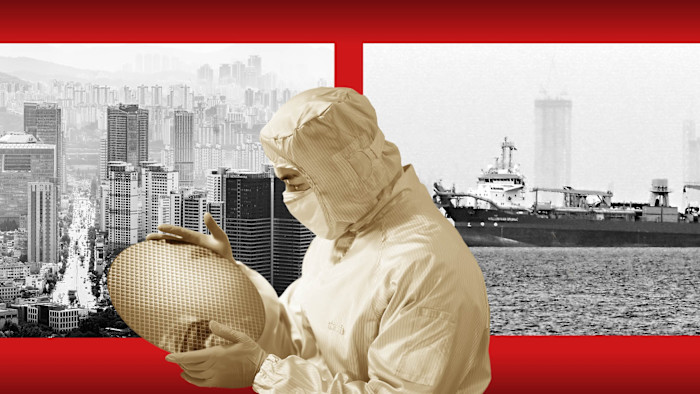
Asia’s biggest manufacturing economies are racing to secure new sources of oil and gas, preserve stockpiles and co-ordinate to provide supplies in case of acute shortages, fearing a protracted conflict in the Middle East will choke energy supplies and hammer their economies.
Countries across Asia are highly dependent on oil and gas sent through the Strait of Hormuz, a critical waterway where shipping has slowed to a near standstill in the wake of the US-Israeli strikes on Iran.
While oil and gas price spikes have already this week rocked markets in the region and raised concerns about inflation, officials are becoming increasingly worried about a possible shock to physical supplies.
Among the emergency measures taken in recent days, Taiwan’s government announced on Tuesday plans for a mutual assistance framework with Japan and South Korea to help provide a buffer against any acute gas supply shortages.
“These are some of the most energy import-dependent countries in the world among major economies — and are critical in manufacturing supply chains,” said Andrew Gilholm, head of China and north Asia analysis at consultancy Control Risks. “That gets pretty grim, pretty fast.”
Taiwan, the world’s biggest manufacturer of advanced computer chips, relies on imports for more than 90 per cent of its fossil energy sources. The Iran war has added to the urgency of Taipei’s efforts to diversify liquefied natural gas and crude supplies away from the Middle Eastern sources in order to make them less vulnerable to a blockade or attack from China.
Taipei said on Thursday its LNG supplies would last until the end of the month and that it expected to secure sufficient supplies for April. Taiwan hopes to bring forward LNG shipments from the US and Australia and to increase buying in the spot market.
Japan, the world’s fourth-biggest economy and a leading producer of high-tech goods, is establishing a special government office in Tokyo to manage energy supply issues triggered by the escalating Iran conflict and closure of the Strait of Hormuz.
Ryosei Akazawa, Japan’s trade minister and chief of the new “energy countermeasures headquarters”, said it would work “with a sense of urgency”.
“We will do everything we can to ensure a stable energy supply for Japan and respond with all our efforts to minimise the impact on people’s lives and economic activity,” Akazawa said, adding that the country had 254 days’ worth of oil reserves.

South Korea’s government said it would activate emergency energy protocols to manage supply disruptions. These will expand financing for crude purchases from other regions, via loans and credit guarantees, and potentially also allow the release of strategic reserves.
South Korea imports roughly 70 per cent of its crude oil and 20 per cent of its LNG from the Middle East, almost all shipped through the Strait of Hormuz. Korean officials also held emergency talks with energy sector executives on Thursday to review shipping conditions, tanker routes and crude supplies outside the Middle East. The government also warned refineries against raising consumer energy prices.
Alicia García-Herrero, chief economist for Asia-Pacific at French investment bank Natixis, described the situation as “terrible” for Taiwan, South Korea and Thailand, given their high levels of dependence on the Hormuz route and lack of robust strategic reserves.

In China, the government has ordered its biggest refineries to suspend exports of most oil and gas products, as concerns build over possible protracted disruption to the Middle Eastern energy trade.
One China-based energy trader told the FT that the National Development and Reform Commission, a top government economic planning agency, had in recent days told refineries work to reduce refined oil exports as much as possible. Exceptions included aviation and marine fuels as well as fuels being sent from the Chinese mainland to Hong Kong and Macau.
Ye Lin, an Asia oil market analyst at Rystad Energy, said Beijing’s instruction to halt exports could lead to refineries reducing processing from next week to support energy security. China, she said, would “focus on domestic fuel supply and prevent crude inventories from dropping fast”.
Analysts also expect China to turn to Russia to help offset any hit to Middle Eastern supplies and to consider releasing the country’s strategic oil reserves.

In India, oil minister Hardeep Singh Puri told reporters this week that the country was “well stocked with crude oil and inventories of key petroleum products” to handle “short-term disruptions arising from the Middle East”.
Despite those assurances and pressure from Washington on New Delhi to stop buying Russian crude, analysts believe India, which is the world’s third-largest oil importer and reliant on the Middle East for about half its crude, could be forced to turn back to Russia if supply disruptions persist. Washington on Thursday issued a waiver to allow Indian refiners to purchase sanctioned Russian oil for 30 days.
In south-east Asia, Thailand, Singapore and the Philippines have also all voiced concern about supplies.

Indonesia, the region’s biggest economy and the world’s biggest exporter of thermal coal, is increasing crude oil purchases from the US to replace Middle East supply.
Bahlil Lahadalia, Indonesia’s energy minister, said the country had oil reserves for about 23 days and would also begin constructing new crude oil storage facilities to increase its reserves. However, the world’s fourth-most populous country will soon enter its Eid holiday peak travel season, straining current stocks.
Pakistan, which borders Iran, relies on shipments through the Strait of Hormuz for most of its oil and gas imports. Authorities say they hold about a month’s worth of petrol and diesel but only 10 days of crude. Conservation measures being considered include mandating work from home and remote university classes, as well as cutting gas supplies to fertiliser plants.
Australia, an LNG exporter, stands to benefit from regional energy diversification efforts but also faces a domestic crunch for transport fuels. Tim Buckley, director of the Climate Energy Finance think-tank, said that at the start of the year Australia had just 25 days’ worth of diesel reserves and 29 days of petrol. “We have essentially no buffer against what is unfolding,” he said.
Reporting by Edward White and Wang Xueqiao in Shanghai, Cheng Leng in Beijing, Kathrin Hille in Taipei, Leo Lewis in Tokyo, Andres Schipani in New Delhi, Humza Jilani in Islamabad, A Anantha Lakshmi in Jakarta, Daniel Tudor and Song Jung-a in Seoul, Owen Walker in Singapore and Nic Fildes in Sydney
Data visualisation by Cleve Jones and Martin Stabe
Source link