Unlock the Editor’s Digest for free
Roula Khalaf, Editor of the FT, selects her favourite stories in this weekly newsletter.
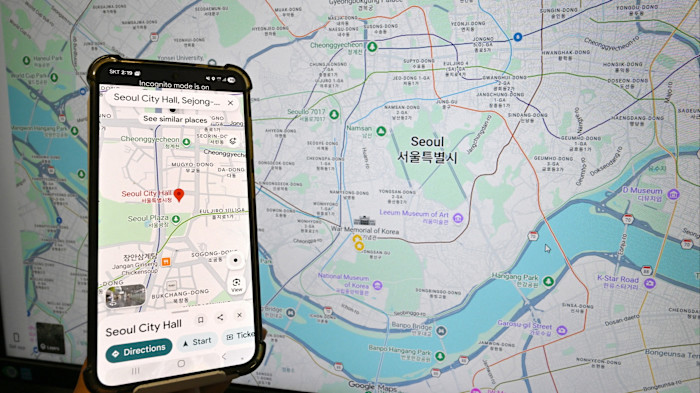
Google Maps has gained conditional approval to fully operate in South Korea, one of the last countries where the app does not work properly, resolving an issue that has long frustrated the US tech company and foreign tourists.
The country’s transport ministry said on Friday it would allow Google Maps to export local data “on the condition that strict security requirements are met”. The ministry will require Google first to process the data on domestic servers and receive government clearance before exporting it.
The decision ends a decades-long dispute with the tech company. Google has made repeated requests since 2007 to export detailed geographical data to overseas servers, but Seoul had refused unless the company set up a local data centre, citing national security concerns as South Korea is still officially at war with North Korea.
The lack of access meant Google Maps could not provide users with walking or driving directions, frustrating many foreign visitors and making South Korea one of the few countries — alongside China and North Korea — where the app cannot function properly.
The rule, which also affects Apple Maps, has helped local rivals such as Naver and Kakao dominate the market.
But Seoul has been under growing pressure to ease business obstacles after officials in Washington, including trade representative Jamieson Greer, accused South Korea of discriminating against US tech companies and threatened to raise tariffs.
Most recently, relations have been strained by Seoul’s investigation of Coupang, an ecommerce retailer that is dominant in South Korea but has its headquarters in Seattle. The company is being probed on a data breach in December that leaked the personal information of nearly two-thirds of South Korea’s population.
On Monday, Harold Rogers, interim chief executive of the South Korean subsidiary of Nasdaq-listed Coupang, testified at a closed-door session of the US House Judiciary Committee at the request of chairs Jim Jordan and Scott Fitzgerald.
“The government seems to have bowed to US pressure because of Trump’s threat to increase tariffs on Korea,” said Wi Jong-hyun, business professor at Chung-Ang University in Seoul. “Google effectively used Korea’s fear of trade tensions to win government approval.”
The transport ministry on Friday said it had made the move after considering its economic impact on the tourism sector.
South Korea will allow Google to export 1:5,000-scale digital map data, in which each unit on a map represents 5,000 units on the ground. This will clear the way for improved navigation, driving and other location-based functions.
Previously, Google was restricted to using less-detailed 1:25,000-scale data, which significantly weakened its competitiveness against local rivals.
Google will also be required to blur sensitive areas, including military bases, rent local servers to process map data and employ a compliance officer in Seoul. The ministry said it could suspend or revoke its approval if Google failed to comply with the conditions.
Cris Turner, a vice-president at Google, welcomed the decision and said the company “looks forward to ongoing collaboration with local officials to bring fully functioning Google Maps to Korea”.
Source link