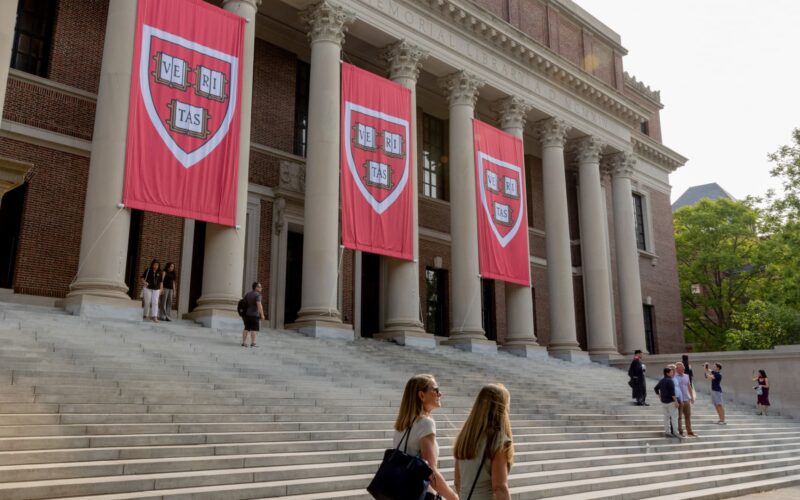
With the Trump administration reigniting its battle with Harvard University, future applicants may be wondering where they stand.
In the latest blow, the government sued Harvard on Feb. 13 for withholding race-related admissions data in the wake of the Supreme Court‘s 2023 ruling that the Ivy League’s affirmative action admission policies were unconstitutional.
“Harvard has failed to disclose the data we need to ensure that its admissions are free of discrimination — we will continue fighting to put merit over DEI across America,” Attorney General Pamela Bondi said in a statement announcing the lawsuit.
After the Supreme Court declared race-conscious admissions unconstitutional, the Justice Department initiated compliance reviews of Harvard’s undergraduate, medical school and law school programs. The objective was to determine whether Harvard continued to “unlawfully discriminate against applicants for admission on the ground of race,” according to the complaint.
The Justice Department said that Harvard “slow-walked” the pace at which it produced the documents requested by the DOJ.
“If Harvard has stopped discriminating, it should happily share the data necessary to prove it,” Assistant Attorney General Harmeet Dhillon of the Justice Department’s Civil Rights Division also said in the press release.
The lawsuit itself is a partially strategic move, according to Jamie Beaton, co-founder and CEO of Crimson Education, a college consulting firm.
“Harvard is the wealthiest university with a $56.9 billion endowment,” Beaton told CNBC. “There is definitely a scapegoating, both on the side of the government … and, in turn, Harvard feeling that sense of moral responsibility to set precedents that are largely favorable for their peers that don’t have as many resources to fight back.”
In a statement emailed to CNBC, Harvard said it “has been responding to the government’s inquiries in good faith and continues to be willing to engage with the government according to the process required by law.”
Since the 2023 Supreme Court ruling found that race-conscious policies discriminated against Asian American applicants, the admissions office doesn’t consider, look at or review the racial and ethnic composition of the applying class until the admissions cycle is complete, including waitlists, according to a university spokesperson.
Among other measures, Harvard also reinstated standardized testing requirements in 2024 as part of the admissions process, “which recent research has affirmed is valuable for identifying talent from across the socioeconomic range,” the spokesperson said.
What lawsuit may mean for future Harvard applicants
Still, experts say the Supreme Court’s decision was a major setback in efforts to boost enrollment of minorities from marginalized backgrounds through policies that took into account applicants’ race.
In the admission cycles that followed the ruling, “Harvard has largely complied,” Beaton said.
“If you look at the data, there’s been a massive growth in the number of Asian Americans getting in,” he said.
For the Class of 2029, Asian American students made up 41% of roughly 2,000 admitted students, up from 29.9% for the Class of 2027, the last class admitted before the ruling on affirmative action. “When you look at those numbers, it would suggest they don’t really have all that much to hide,” Beaton said.
Students walk on campus at Harvard University, in Cambridge, Massachusetts, U.S., Nov. 19, 2025.
Reba Saldanha | Reuters
By compelling Harvard to make this admissions data more accessible, “this lawsuit has broken open the long-secret world of ‘holistic admissions,'” said Christopher Rim, president and CEO of Command Education, a New York-based college consulting firm.
“Asian American students at elite institutions have long suspected that the game was rigged — now, we know that for certain,” he said. “However, while this may diminish the university’s sheen in the eyes of some, it’s unlikely to dramatically change the demand for a Harvard education,” he added.
How the college acceptance landscape is changing
At the nation’s most elite colleges, including the Ivy League, applications have only continued to skyrocket, driving acceptance rates near rock bottom. Harvard’s acceptance rate was under 4% for the Class of 2029, down from more than 10% two decades ago; similarly, both Princeton and Yale had acceptance rates under 5%, down from 12% and 10%, respectively. Battling with the federal government is unlikely to change that trend, experts say.
For students applying to Harvard or other top colleges in the years ahead, “the general advice is that academics have become an even more important priority than they have been historically,” Beaton said.
“The bar for academic rigor has gone up,” he said. “I would say full steam ahead on the academics and don’t blink too much on the lawsuits.”
Source link