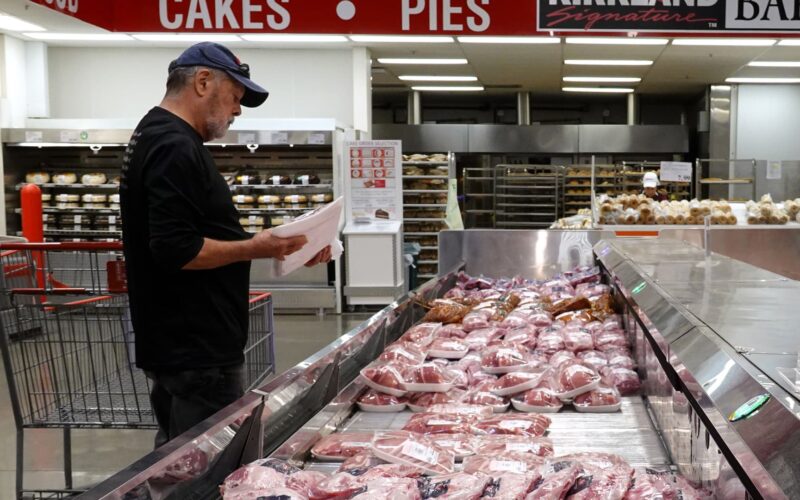
A worker stocks angus beef top sirloin filets in the meat section of a grocery store in Washington, D.C.
Tom Williams | Cq-roll Call, Inc. | Getty Images
Inflation slowed unexpectedly in November, as a deceleration across a range of consumer products outweighed price pressures in categories like gasoline — but economists said the numbers should be interpreted with caution due to spotty data collection during the government shutdown.
The consumer price index, a key inflation barometer, rose 2.7% in November from a year earlier, the Bureau of Labor Statistics reported Thursday.
That was a slowdown from a 3% inflation rate in September, the last month of available data, and came in lower than expected.
“Inflation fell quite sharply,” said Thomas Ryan, a North American economist at Capital Economics.
“[But] I think we’re slightly suspicious of some of these numbers, to be honest,” he said. “It wasn’t a usual month.”
First CPI report since shutdown ended
The CPI report issued Thursday was the Bureau’s first since the record-long government shutdown ended last month.
The BLS didn’t collect inflation data for October and was only able to gather data for roughly half of November due to the shutdown, which ran from Oct. 1 to Nov. 12.
That gives the public an incomplete view of how consumer prices have moved in recent months, economists said.
It also may have skewed certain data readings. For example, since the government’s data sample occurred from the middle to end of November, prices for goods may have inadvertently captured more Black Friday sales and looked artificially low, Ryan said.
So-called “core” goods inflation — i.e., physical goods minus those tied to food and energy — fell to 1.4% in November from 1.5% in September, according to the Bureau’s report.
Many economists expected upward pressure on goods prices to persist at least partway into next year due to the Trump administration’s tariff policy.
“I think we should absolutely take the results with a grain of salt, given these technical issues we’re talking about,” said Tom Porcelli, chief economist at Wells Fargo. “It’s a very messy report.”
Prior to the November reading, the inflation rate had been edging up gradually since April, when it was at 2.3%.
If one were to take this CPI report at face value, “it looks like inflation is coming back down,” Ryan said.
If that trend were to persist, it would be good for consumers’ wallets since it would mean prices are growing more slowly and that their wages after accounting for inflation would generally increase, Ryan said.
It might also give the green light to the Federal Reserve, the U.S. central bank, to cut interest rates next year and relieve some pressure on debt holders, he said.
Some economists are skeptical of inflation’s trajectory, however.
“Once all of the dust settles, I think the story on inflation is, it really hasn’t moved all that much,” Porcelli said.
Fed policymakers seem to be more focused on the labor market, which has showed signs of cooling, rather than inflation, said Joe Seydl, a senior markets economist at J.P. Morgan Private Bank.
“I think inflation has taken a back seat to the labor market data,” Seydl said.
Slowing wages should also put downward pressure on inflation in the services sector of the economy, said Seydl, since it tends to be more sensitive to labor costs.
Slowing inflation doesn’t mean affordability
Additionally, declining inflation doesn’t mean the same thing as falling prices, economists said.
Inflation measures the rate of change of prices, while affordability is more about the actual price level, Seydl said.
A University of Michigan consumer sentiment survey from November showed rising frustration over high prices among households. The share of consumers that spontaneously mentioned the negative effects of high prices on their personal finances rose for the fifth consecutive month, to 47%, up from 34% in January 2025, according to the survey.
“While the rate of change has slowed down, the price level continues to advance, and that’s what people are feeling,” Porcelli said.
Food is one of the major categories where consumers are feeling price pressures, he said.
Beef prices have soared as cattle supply touched its lowest point in 2025 since the early 1950s. The annual inflation rate for uncooked beef roasts was about 21% in November, according to the CPI report.
Coffee prices are also up about 19% from a year ago, on the back of extreme weather in major coffee-producing countries and Trump administration tariffs levied on Brazil, for example.
Banana prices are also up about 7% over the past year.
“Food is a category that most people feel on a daily basis,” Porcelli said. “A lot of that has to do with tariffs.”
However, President Donald Trump last month exempted certain agricultural imports like beef, coffee, cocoa and bananas from tariffs amid political blowback over affordability. It’s unclear whether that will deliver relief from high grocery prices any time soon.
Source link