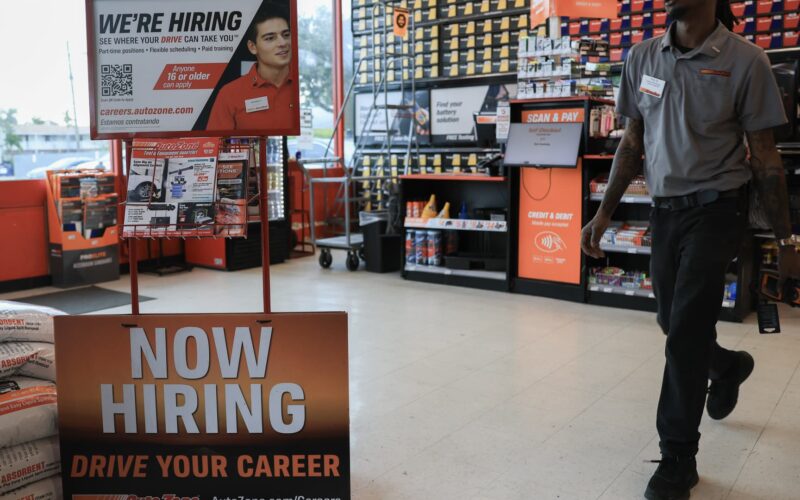
A “Now Hiring” sign is seen at an AutoZone on Feb. 11, 2026 in Hollywood, Florida.
Joe Raedle | Getty Images
With the upheaval of the Covid pandemic came opportunity, as a shift in the labor market gave workers unprecedented opportunities for mobility and a chance to climb the pay scale.
The Great Resignation, as it came to be known, saw record amounts of employees quit, leaving for better opportunities as companies couldn’t hire workers fast enough to fill the vacancies that the pandemic helped create. A record 4.5 million left their jobs for greener pastures in March 2022.
But that is changing.
The level of “quits” as measured by the Bureau of Labor Statistics has contracted by nearly one-third since hitting its peak in early 2022, a period during which job openings have nearly halved.
One metric helps further tell the story: During the same period, the disparity between average annual pay increases for those staying in their jobs against those leaving has all but collapsed, going from a peak of 8.4 percentage points in April 2022 to 1.9 percentage points in January, the lowest level since payrolls processing firm ADP began tracking the data in November 2020.
Call it the Big Stay, or just another outgrowth of the low-hire, low-fire labor market, but it’s a trend that has significance for workers.
A pendulum swing
“It’s a very stable labor market. There’s very little hiring, very little firing,” said Nela Richardson, chief economist at ADP. “It’s an outgrowth of the pandemic from where it was all hands on deck.”
A lack of labor supply and a pernicious skills gap was the story when the economy was trying to recover from the massive drawdown it had seen during the early Covid days. Workers and employers were adjusting to the new world of hybrid work, and companies were hungry for new recruits.
As the Great Resignation peaked, there were more than two job openings per each worker the BLS classified as unemployed. That pendulum has swung back, however, and there are now more available workers than openings.
Layoffs, though, remain low. Last week saw just 206,000 initial jobless claims, with the longer-term average at 219,000, about in line with historical norms for a healthy labor market. Though hiring has slowed considerably, the unemployment rate is just 4.3%.
“if you were to parachute into this labor market in any time period of the United States, you’d be mostly happy with what you found,” Richardson said. “The action is in the granular data.”
For instance, pay trends are peculiar to industries.
In the high-turnover leisure and hospitality industry, pay gains are better for job stayers, with the disparity at 2.5% in stayers’ favor, according to ADP. However, construction, which is struggling with labor supply during the U.S. crackdown on illegal immigration, has a 6.6 percentage point advantage for switchers.
To be sure, the incentives are still strong for switchers, with annual pay growth averaging 6.4% in January, well above the 4.5% for stayers, according to ADP data. But the gap is narrowing and could close further due to current labor market moves.
A new reality
The trends come with a fresh flock of workers combing the want ads for jobs.
Searches were up 31% in January from December while job postings were little changed, according to the Indeed Hiring Lab.
“The reality facing those seeking jobs in 2026 is that openings per unemployed person have declined, and hiring timelines are lengthening,” Indeed experts Laura Ullrich and Sneha Puri wrote. “While some sectors continue to see elevated levels of postings, the macro environment remains in the low-hire, low-fire stagnation of 2025.”
Even with the low unemployment rate, Richardson said she is concerned with the “lack of dynamism in the labor market” as most hires are in the health-care industry and turnover is receding.
“The fact that it is low-hire, low-fire is actually not a great state to be in. The churn is important to the productivity growth,” she said. “You want to see the most talented go to the places where that talent is the most rewarded. And if we are in this really stable period, that means that talent is not being repositioned to its best use.”
Source link