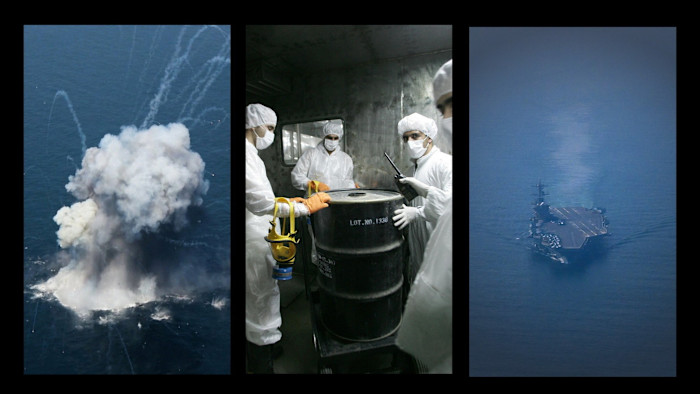
As oil prices surge and Donald Trump orders one of the largest American military build-ups in the Middle East since the Iraq war, negotiations between the US and Iran increasingly resemble a race against time to avert a new regional conflict.
Both sides met for a second round of nuclear talks this week, with Iran’s foreign minister Abbas Araghchi reporting “good progress” and a US official saying Tehran would come back within two weeks with “detailed proposals”. But the cautious optimism was tempered by US vice-president JD Vance, who accused Iran of being unwilling to acknowledge Trump’s “red lines”.
White House press secretary Karoline Leavitt reiterated on Wednesday that while “diplomacy is always his first option”, there are “many reasons and arguments that one could make for a strike against Iran”. She spoke as a second US aircraft carrier and dozens of other military aircraft headed towards the region.
The competing narratives unscored the perilous path forward, with huge, complex barriers facing the diplomatic push to avert a new war between the arch-foes.
Vali Nasr, a professor at Johns Hopkins University, said it would take “a kind of diplomatic ju-jitsu” to broker an agreement acceptable to both.
A core faultline is the long-running dispute over the question of Iran’s uranium enrichment programme. Trump has repeatedly insisted Tehran permanently dismantle its capacity to enrich, which is a red line for Iran’s supreme leader Ayatollah Ali Khamenei.
The challenge is how to break the deadlock in a way that enables both the unpredictable American president and Iran’s defiant leader to save face.
One option would be a deal that does not explicitly force Iran to give up its right to enrich uranium — a process that can yield nuclear fuel and weapons-grade material — but in which it agrees to suspend all enrichment indefinitely.
Iran is not thought to have enriched uranium since the US joined Israel’s 12-day war last June to bomb the republic’s three main nuclear facilities, meaning that would in effect be a formalised extension of the status quo.
But inspectors also have not been allowed complete access to what remains of the programme. Richard Nephew, a nuclear expert and former US official, said the “verification challenge is the biggest, most insurmountable issue for doing a nuclear deal at this point on technical grounds”.
Analysts expect that Tehran would also have to ship off its stockpile of fissile material, including more than 400kg of uranium enriched close to weapons grade, and accept stringent international monitoring of its facilities.
It agreed to similar measures under the 2015 deal, known by its acronym JCPOA, which it signed with the Obama administration and other world powers. That accord limited it to enriching uranium to a purity level far below what is needed for nuclear weapons and capped its stockpile of enriched uranium at 300kgs.
But the deal collapsed after Trump abandoned it during his first term, following which Iran installed advanced centrifuges and built a stockpile of almost 10,000kgs of enriched uranium. His decision to withdraw from the accord in 2018 and then to join Israel’s war last June as Washington and Tehran were holding talks, deepened decades of distrust.

Another previously mooted option is the establishment of a regional “consortium” that would not be on Iranian territory, but would allow Iran and others to enrich to low levels for civilian purposes. Tehran has insisted, however, that this could not be a substitute for its own programme.
Regional states — which have facilitated the talks and are desperate to prevent a US attack they fear would spill over their borders — say the Trump administration has signalled it could be willing to show some flexibility on the nuclear issue. The White House declined to comment on the suggestion.
Yet analysts and diplomats expect Trump would need to walk away with a deal that he can claim is bigger than the 2015 accord former-president Barack Obama signed up to.
Trump’s administration has said the talks should also include curbing Iran’s ballistic missile arsenal and ending its support for regional militants. Iran, however, insists those topics are off the table, arguing the focus should solely be on the nuclear programme.
Regional diplomats have said each issue should be negotiated one at a time, the hope being that a breakthrough on the nuclear programme could build trust. Turkish foreign minister Hakan Fidan told the FT last week that regional powers could play a role in addressing concerns around Iran’s ballistic missile threat, adding: “We are trying to develop creative ideas.”
Nephew believed Trump had more latitude than the Iranians to accept a deal, as long as he could claim his military pressure forced the Islamic regime to concede to something more substantive than the JCPOA.
“If the president were to come out tomorrow and say: ‘Good news! . . . the Iranians have agreed that they will not have any uranium enrichment for a decade, and we’re going to keep talking about missiles, proxies and other things which they never agreed to talk about with Obama,’ I find it hard to believe the US political system wouldn’t say, ‘well, that’s actually pretty good’,” Nephew said.
Without breaking the impasse on enrichment there is no chance of progress on other issues critical to the respective sides, including sanctions relief for Iran.
“The Iranians are being clever by saying the talks are only about the nuclear issue and sanctions, not other matters,” said a western diplomat. “But [focusing] solely on enrichment will not satisfy the Americans. The US does not believe that something similar to the JCPOA would work.”

Ali Vaez, an Iran expert at Crisis Group, said even if Trump were willing to allow some low-level enrichment, akin to the JCPOA, that also might not be sufficient to allow Khamenei to save face.
“What the Iranians want is not just relief from the looming military threats, but they also need reprieve from the economic pressure,” he said.
Hamid Ghanbari, a deputy foreign minister, told Iranian businessmen this month that any agreement would have to unfreeze Iran’s oil money held overseas, which amounts to tens of billions of dollars. He also sought to appeal to Trump’s penchant for financial deals, saying US investments in gas, oil and mining had been discussed.
The White House declined to say whether Trump will consider sanctions relief.
Some analysts believe that his amplified threats in the wake of Iran’s brutal crackdown on anti-regime protests last month — which killed thousands — and the US military build-up could create momentum towards conflict that will be hard to back away from.
“You have arrayed this huge armada into the region,” Susan Ziadeh, former US ambassador to Qatar under Obama, said. “The fact that you have so much firepower . . . creates a momentum of its own. And sometimes that momentum is a little hard to just put the brakes on.”
Iran is also expected to want clear details and assurances as part of any agreement given its suspicions of the US — not a nebulous deal akin to Trump’s Gaza peace plan, which left many of the key issues to be dealt with later.
Yet a comprehensive deal would require time that Iran may not have, and technical expertise and bandwidth that Trump’s negotiating team lacks, analysts said.
So far, there have been just a few hours of indirect talks between the parties. In comparison, the JCPOA took almost two years to get over the line.
Vaez said that “the pace of military mobilisation is higher than the pace of negotiation”.
After last year’s negotiations failed to avert the June attack by Israel and the US, Iranian hardliners believe the best way to avert a new war is to make clear that this time they will make America bleed, Nasr said at a roundtable event this week.
They know that Trump “wants things nice and neat”, like the swift capture of Nicolás Maduro in Venezuela, Nasr added. “And they’re trying to convince him that this is going to be messy.”
Some in the Trump administration have meanwhile predicted that a new military operation — should the US resort to that — would play out much like the June war, with minimal damage inflicted in retaliatory strikes because Iran is so weakened.
Both assumptions represent potentially dangerous miscalculations, Nasr said. “We’re in a scenario where this could get out of hand very quickly.”
Source link