Unlock the Editor’s Digest for free
Roula Khalaf, Editor of the FT, selects her favourite stories in this weekly newsletter.
The UN is seeking to draw corporate leaders back to global climate talks, arguing that the summit process is entering a “new era” that is focused less on pledges and will bring more opportunities for investment.
The approach comes as many companies have backtracked on green pledges amid a political backlash led by US President Donald Trump, who has attacked clean energy policies and withdrawn from the UN climate treaty, and as economic pressures weigh on boardroom priorities.
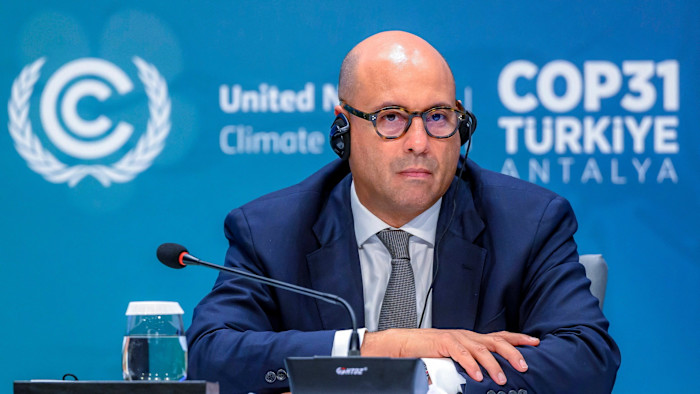
Simon Stiell, executive secretary of the UN climate arm, said efforts to address climate change would not be met “without bringing the real economy closer into the COP process”.
“This new era is about speeding up and scaling up implementation [of UN agreements], which will mean new opportunities for corporate and financial leaders,” Stiell told the FT.
Business needed to engage more directly with policymakers on “big sectoral dealmaking” in areas such as food and agriculture, as well as renewable energy, electrification and climate resilience, he said.
Despite what Stiell described as a “new world disorder” and unprecedented strains on international co-operation, he argued that the shift towards a lower-carbon economy was gathering pace.
Global investment in clean energy technology reached $2.2tn in 2025, double the $1.1tn spent on fossil fuels, according to the International Energy Agency. China accounted for more than a quarter of global energy investment, spending over $600bn on clean energy in 2024.
“Leaders of major economies like China, the EU and almost all others are calling it the trend of the future, and a central driver of growth and jobs,” Stiell said.
At the COP28 summit in Dubai, nearly 200 countries agreed to triple renewable energy capacity and double energy efficiency by 2030 and to transition away from fossil fuels by mid-century.
While business leaders were highly visible at meetings in Glasgow, Sharm el-Sheikh and Dubai, corporate attendance was notably thinner at subsequent gatherings in Baku and Belém — the latter partly hindered by the logistics of its Amazonian location.
Speaking in Turkey on Thursday, Murat Kurum, the incoming president of the COP31 to be held in Antalya, said this year’s summit would focus on “concrete results” including investment commitments.
“Investment, policy alignment, and concrete implementations supported by public and private sector collaborations will be prioritised,” he said.
In launching its effort in Antalya, the Turkish hosts failed to mention the central issue of a so-called roadmap to transition from fossil fuels.
Despite efforts by a group of countries to embed it into the COP30 agreement in Brazil, it failed to be included. Brazil has said it would lead the push for a “coalition of the willing” by developing its own roadmap, and encourage other nations to follow suit.
Turkey’s COP31 launch presentation focused largely on tourism and waste management, however. Turkey’s first lady Emine Erdoğan in 2017 launched a “zero waste” initiative that promotes individual action and the so-called circular economy. It was a key supporter of the Turkish bid to host the UN climate summit.
Climate Capital

Where climate change meets business, markets and politics. Explore the FT’s coverage here.
Are you curious about the FT’s environmental sustainability commitments? Find out more about our science-based targets here
Source link