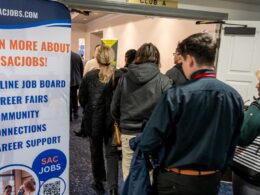
A recruiter displays information while speaking to a jobseeker during the WorkSource North Seattle Career Fair in Seattle, Washington, US, on Tuesday, Feb. 10, 2026.
David Ryder | Bloomberg | Getty Images
January job gains were better than anything the U.S. economy saw in 2025 but not still enough to sound an all-clear on what has otherwise been a stagnant labor market.
With a gain of 130,000 nonfarm payrolls and the unemployment rate slipping to 4.3%, the lowest since August, the numbers indicated that hiring is at least hanging in there while layoffs appear contained.
However, beneath the hood there were some trouble spots: A continued concentration in just a few fields where hiring is happening; revisions that meant virtually no gains in the second half of 2025, and questions over what happens from here as companies contend with a high level of uncertainty.
“I would anticipate that for the rest of the year, job growth is going to be quite subdued,” said Gregory Daco, chief economist at EY-Parthenon. “Whether it’s as subdued as 2025 … is still an open question. But I would not expect job growth to be higher than 50,000 for the remainder of 2026.”
Indeed, revisions the Bureau of Labor Statistics released Wednesday put job gains last year at just 15,000 a month. The last six months of the year produced a net loss of 1,000 jobs. In the recent words of Federal Reserve Governor Christopher Waller, the year’s job growth was close to “Zero. Zip. Nada.”
Also, nearly all the January jobs came from health care-related sectors, raising questions over the ability of displaced and new workers to be able to get hired.
On top of the anemic gains, Daco has another worry. He sees trouble brewing with the receding income gains for cash-strapped consumers possibly causing damage not readily visible in headline economic numbers.
Average hourly earnings advanced 0.4% in January, slightly higher than expected, but the annual gain of 3.71% was the lowest since July 2024. With retail sales unexpectedly flat in December, and consumer spending responsible for more than two-thirds of all U.S. economic activity, that could spell a potential danger sign.
“We’re heading from a jobless expansion to potentially an income-less expansion, because income is essentially the combination of jobs and wages. With both under pressure, that means that for many families, income and income growth prospects are muted,” Daco said.
Questions for the future
So while the monthly numbers are good, whether they are an outlier, or even if they will stand up, remains to be seen. After all, every month in 2025 saw a negative revision from the initial estimate.
The release comes with other economic signs looking strong. Gross domestic product, the broadest measure of growth, is on pace to post a solid 3.7% gain in the fourth quarter after posting 4.4% and 3.8% increases in the prior two periods in 2025, according to the Atlanta Fed.
However, that kind of growth is hard to sustain without stronger job gains, said Rick Rieder, chief investment officer for fixed income at BlackRock.
“One key warning sign is that in past cycles, GDP growth like this has usually required far more hiring. The fact that hiring has slowed while growth has advanced may potentially be an early signal of a productivity boom that we expect to continue,” Rieder said in a note. “While areas like healthcare are still labor intensive, the more interest-sensitive parts of the economy are clearly still under pressure, particularly the lower income segment.”
The state of the labor market and its relation to inflation sets up a policy challenge at the Federal Reserve, which already has seen significant divisions over how to proceed.
Most recently, regional Presidents Lorie Logan of Dallas and Beth Hammack of Cleveland said Tuesday that they don’t see a need to cut rates further with inflation still above the Fed’s target and the labor market stable. As voters this year on the rate-setting Federal Open Market Committee, their positions conflict with those of Governor Waller, who is advocating for more cuts, a position also held by Fed Chair-designate Kevin Warsh.
“I think there is room for the Fed to get a little bit closer to median estimates of neutral policy,” EY’s Daco said. “I don’t necessarily think that that will be the case … in part because a majority of Fed policy makers are more focused on the inflation mandate than on the employment mandate.”
For their part, markets took the view Wednesday that the January payrolls report will temper any urges to cut rates soon. According to the CME Group’s FedWatch tracker, trades are pricing in the likelihood of a cut in March at roughly 6%, though they still see two reductions before the end of the year.
Source link