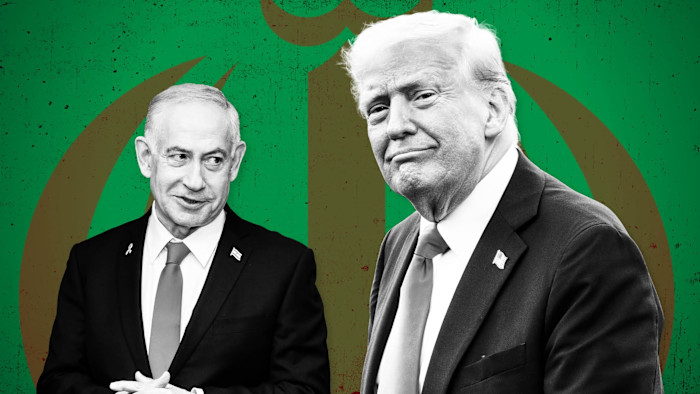
Israeli Prime Minister Benjamin Netanyahu is expected to press Donald Trump to take a hard line in talks with Iran as he makes his seventh visit to the US since the start of the president’s second term.
Netanyahu said on Tuesday that he would present Israel’s “perceptions of the principles in the negotiations” to Trump during their meeting on Wednesday, which would focus “first and foremost” on US discussions with Tehran.
The Trump administration’s renewed efforts to negotiate a deal with Iran on its nuclear programme — and avoid the military strikes that the president has threatened for weeks — have alarmed the Israeli government and Iran hawks in Trump’s Republican Party, who want to see Washington take more aggressive action against the Islamic republic.
“There is no point” in negotiating with Iran, Eli Cohen, a member of Netanyahu’s cabinet, said earlier this week, because “it has never honoured any commitment it has made”.
US and Iranian officials voiced cautious optimism after resuming indirect talks in Oman last week, and Trump said the discussions — the first since the US bombed Iranian nuclear facilities in June — were “very good”.
But pressure from Netanyahu could also mark an inflection point for a US president whom analysts say is prone to “gut-level” policy shifts based on his most recent conversations, sometimes surprising even close aides.
After meeting with Netanyahu at his Mar-a-Lago estate in Florida in late December, Trump, who had in previous months boasted of having “obliterated” Iran’s nuclear enrichment programme, made a sudden pivot.
“Now I hear that Iran is trying to build up again and, if they are, we have to knock them down,” he said with Netanyahu at his side. Trump threatened to “knock the hell out of” Iran and warned that “the consequences will be very powerful” if Iran is found to be “behaving” badly.
“He’s erratic. He is one of these leaders who listens to the last person who talks to him,” said Colin Dueck, a senior fellow at the American Enterprise Institute and an expert on the influence of Republican politics in foreign policy.
A few days after the December meeting, as the regime in Tehran cracked down on protests, Trump raised the ante further, posting on Truth Social that the US was “locked and loaded and ready to go”, adding that if the Iranian regime “violently kills peaceful protesters, the United States of America will come to their rescue”.
But Trump has continued to waver on launching strikes and even those closest to him suggest he has yet to decide the best course of action.
“I think the president is going to make the ultimate decision about where we draw the red lines in the negotiations,” vice-president JD Vance told reporters on Monday.
Ray Takeyh, senior fellow for Middle East studies at the Council on Foreign Relations in Washington, said any pressure on Trump from Netanyahu could be significant because the Israelis are “not interested in an agreement” with Tehran and are alarmed by the talks in Oman.
Netanyahu’s government and the Trump administration also have fundamentally different understandings about what was accomplished in the US strikes on Iran’s nuclear facilities in June.
“The Israelis thought they mowed the lawn. The president thought he burned down the house. The Israelis want to mow the lawn again. And I don’t know if the Americans do at this point,” Takeyh said.
But Iran hawks in Washington have been growing impatient. Some such as South Carolina Republican Lindsey Graham, insist that Trump will follow through with his pledges to help Iranian protesters.
As the president weighs up military action, Washington has deployed an aircraft carrier strike group, fighter jets and air defences to the region.

“To the brave people of Iran: President Trump has always heard your cries and demands for justice. The regime has proven yet again it’s incapable of real change,” he wrote on X after Iran this week jailed reformist politicians. Graham added: “If this regime continues the course they are on, then I believe President Trump’s statement that help is on the way is becoming more real by the day.”
Other Iran hawks say that a failure by Trump to deliver on his threats would harm US credibility.
“This is no time for negotiations,” former vice-president Mike Pence wrote on X earlier this month. “If necessary, the United States military must be ready to deliver the death blow to the Iranian regime. There can be no off-ramp or shelter in the international community for the leading state sponsor of terror in the world.”
Edmund Fitton-Brown, senior fellow at the Foundation for Defense of Democracies think-tank, warned: “If the United States walks away leaving the Islamic republic with time to regroup, re-arm and continue to kill people who were involved in the demonstrations, then the US will be seen and loudly said to be the loser in this.”
But most Iran experts say that limited US strikes would be unlikely to topple the regime in Tehran, complicating the calculation for Trump.
The president “was really gung ho after Venezuela” one former Trump administration official said of his attitude towards Iran. “And then the reality of the situation set in for him, and that caused him to walk back.”
“That’s not to say that he’s not going to change his mind, or he may arrive at some type of symbolic [action] . . . But the gap between what we’re saying we want to do and achieve versus what we can do is incredibly big,” the official added.
Trump has deliberately eschewed a traditional policymaking process in his second term, and his openness “to ideas from any direction” imbues his decision-making with uncertainty, Dueck at the American Enterprise Institute said.
He added: “He honestly believes that in relation to Iran — and in relation to almost any other country — that ideologies should be taken with a grain of salt, that the real goals should be to promote US interests in the most material way, that you should be willing to go up and down the ladder of escalation; be willing to make a deal with pretty much anybody, but also be willing to pressure pretty much anybody.”
Source link