Unlock the Editor’s Digest for free
Roula Khalaf, Editor of the FT, selects her favourite stories in this weekly newsletter.
Good morning. The market response to yesterday’s earnings reports from Meta and Microsoft puzzled us. Meta’s shares rose sharply in late trading, reflecting strong top-line results and a bright outlook. We would have thought its much higher capital spending would have spooked investors growing wary of an AI bubble. Meanwhile, Microsoft’s revenue and profits looked very healthy, but the market seemed less forgiving of its own investment spending. The stock sold off hard. Is there something we’re missing? Let us know your thoughts: unhedged@ft.com.
Yesterday afternoon’s Federal Reserve meeting didn’t move markets much. Short-term interest rates edged up at first, then dropped back again. The dollar strengthened a touch. Stocks didn’t care a bit.
But it’s not as if nothing has changed. The Fed made it very clear that it is adjusting its posture. Before it had been looking to ease; now it’s happy where it is, until more information arrives. The shift was evident in the press release. December’s statement said “economic activity has been expanding at a moderate pace”. Yesterday this became: “Economic activity has been expanding at a solid pace.” Similarly the observation that “the unemployment rate has edged up” was replaced with “unemployment rate has shown some signs of stabilisation”. Talk of “the shift in the balance of risks” — towards unemployment and away from inflation — was dropped altogether.
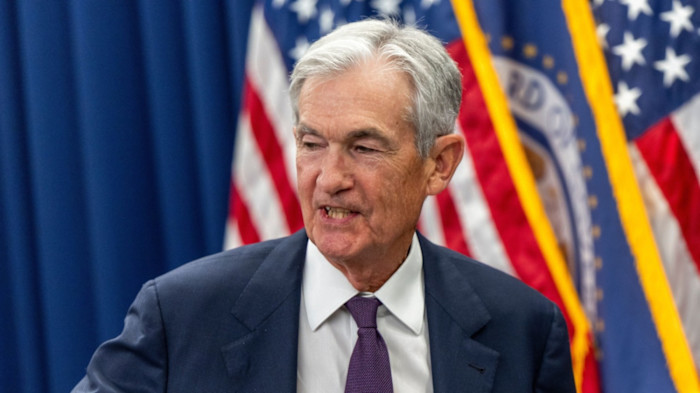
Jay Powell’s press conference reinforced the point. “I think, and my colleagues think, that it is hard to look at the incoming data and think policy is meaningfully restrictive,” the central bank chair said. If nothing changes, rates are staying where they are. The message was not diluted by the two dissenting votes, one of which (Stephen Miran’s) came from the president’s de facto representative on the committee, and the other (Christopher Waller’s) from a man in running to replace Powell and would have taken himself out of contention by agreeing with the majority.
Don Rissmiller of Strategas summed up the shift neatly: “The FOMC overall looks set to turn the ‘skip’ in January into a longer ‘pause’.”
Why the market indifference, then? Because a stronger economy has left the Fed no other option, and the market knew it. Real US GDP grew at 4.4 per cent in the third quarter and seems unlikely to have slowed in the fourth. Consumption is strong. Corporate earnings are strong and markets are peaky. Inflation is a percentage point above target, and we just got over a historically bad inflationary incident. For the central bank to signal to the market that it might still be in cutting mode would be bonkers.
President Donald Trump’s idiotically self-defeating attempts to bully the Fed only made the shift posture more of a certainty. The ham-handed bullying has forced the committee to care more about its inflation-fighting credibility. On the topic of the intimidation campaign, Powell refused to engage yesterday, with one exception. He was asked why he attended the Supreme Court hearings concerning the president’s right to fire Fed governor Lisa Cook. It would have been odd not to attend, Powell said, given that it is the most important legal case in the central bank’s history. Quite right.
The falling dollar
The dollar index is down 2.5 per cent in the past week, the fastest drop since last April’s “liberation day” tariff farce:
This is doubly striking. It is happening when the US economy is growing very strongly relative to the rest of the world, which all else equal should support the currency. And it is happening when the gap between US interest rates and the rest of the world is tightening — which, again, the textbooks say should strengthen the dollar. This chart below comes from Jonas Goltermann of Capital Economics. It maps the dollar index against the yield gap between five-year Treasury yields and yields on a basket of developed-world sovereign bonds. The last big separation was after “liberation day”:

Such gaps are a good sign that a weakening currency reflects a country’s politics, not its economics, Goltermann says. While global investors are still keen on buying US assets — US Treasuries offer good yields and unparalleled liquidity, US companies are the best in the world — they want to hedge away currency risk created by Trump’s erratic approach to economic policy. And when traders hedge dollars in the forward market, it forces the currency down.
And it was a doozy of a week for erratic policy. On the heels of the Greenland tariff threats and their reversal, the Treasury signalled concern with the weak yen with a rare “rate check”; the president said a weak dollar was no problem; and the Treasury secretary said, in the face of all evidence and much logic, that the US still has a strong dollar policy.
The “rate check” — essentially a performative inquiry into what it would cost to intervene in the dollar/yen market — was probably intended to remind a US political ally, Japan’s Prime Minister Sanae Takaichi, that the US is a useful friend, and Tokyo should follow through on its commitment to investing in the US. But the market might have read it as expressing the administration’s fear that Japan’s fast-rising yields could be transmissible to the Treasury market.
In the background, notes Karthik Sankaran of the Quincy Institute for Responsible Statecraft, is the running conflict between the administration and the Fed, a bigger threat to dollar stability than any tariff adventure or market intervention.
Ed Al-Hussainy of Columbia Threadneedle, Unhedged’s rates svengali, points out that all these sorts of antics spark a cycle. They weaken the dollar, which encourages owners of US assets to hedge the dollar; the hedging weakens the dollar further; which encourages more hedging, and so on.
None of this should be confused with de-dollarisation, still less a sell-America trade. It is just an implicit acknowledgment by asset owners around the world that exposure to the dollar, once an added bonus tacked on to purchases of US assets, is now a risk that must be insured against, at a cost.
One good read
FT Unhedged podcast

Can’t get enough of Unhedged? Listen to our new podcast, for a 15-minute dive into the latest markets news and financial headlines, twice a week. Catch up on past editions of the newsletter here.
Source link