This is an on-site version of the White House Watch newsletter. You can read the previous edition here. Sign up for free here to get it on Tuesdays and Thursdays. Email us at whitehousewatch@ft.com
Good morning and welcome to White House Watch. On today’s agenda:
-
Trump’s Davos rollercoaster
-
Supreme Court caution over case against Fed’s Lisa Cook
-
The US president’s popularity numbers
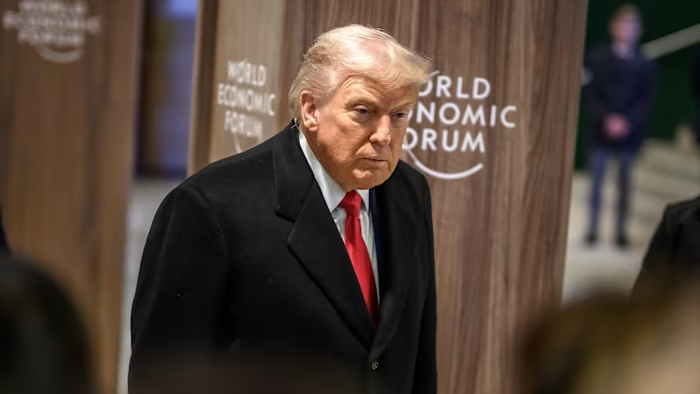
It has been a chaotic 24 hours since Donald Trump touched down in Davos. But after a rollercoaster day, it appears the threat of a resurgent transatlantic trade war has receded — for now at least.
The US president said yesterday evening he was ditching plans for fresh tariffs on European countries after reaching “the framework of a future deal” over Greenland, as my colleague James Politi reported from Davos.
Details of the deal — announced after what Trump said were “very productive” talks with Nato secretary-general Mark Rutte — were vague at best, with the president suggesting it would involve mineral rights and a defence arrangement involving his “Golden Dome” missile defence system.
Denmark and Greenland have repeatedly insisted that the island is not for sale.
Following Trump’s announcement, Danish foreign minister Lars Løkke Rasmussen reiterated that US ownership of Greenland was a “red line”. But he added: “The day ends better than the day started”. Many of his European colleagues would agree.
Rutte said he had not discussed whether Greenland would remain a Danish territory in his talks with Trump.
Trump had kicked off his visit to the Swiss mountain resort by delivering thinly veiled threats to America’s Nato partners and demanding “immediate negotiations” over the future of Greenland.
“We want a piece of ice for world protection, and they won’t give it,” he said in a lengthy address to the business and political elite gathered at the World Economic Forum. “So they have a choice. You can say yes and we will be very appreciative, or you can say no and we will remember.”
The president’s threat of tariffs against European countries had rattled markets, with the S&P 500 posting its worst day since October on Tuesday, while US bonds also came under pressure.
The market wobble on the prospect of a fresh transatlantic trade war is among the key reasons for the president’s climbdown, argues the FT’s chief foreign affairs commentator Gideon Rachman, alongside the resolute pushback from Europe and members of his Republican Party.
Stock and bond markets both rallied yesterday as traders breathed a sigh of relief after Trump walked back his tariff threat.
Details of the framework deal may become clearer in the coming days — and could face serious pushback in Greenland and European capitals. EU leaders are expected to gather in Brussels today for an emergency summit.
Trump, meanwhile, unveiled a charter for his controversial “Board of Peace” which he wants to oversee the redevelopment of Gaza, before returning to Washington, where he is engaged in an aggressive push to bend the US Federal Reserve to his will.
The drama is far from over . . .
The latest headlines
-
US Supreme Court justices appeared wary of Trump’s case for sacking Federal Reserve governor Lisa Cook. Both liberal and conservative members raised concerns about the impact on Fed independence, the rushed nature of the proceedings and whether Cook had been allowed due process.
-
A congressional committee voted to hold Bill and Hillary Clinton in contempt after they refused to testify over links to Jeffrey Epstein. The vote lays the groundwork for possible criminal charges against the prominent Democrats.
-
Israeli Prime Minister Benjamin Netanyahu has joined Trump’s new “Board of Peace”.
-
Ukraine has been caught in the middle of the clash over Greenland. An $800bn “prosperity plan” due to be signed in Davos has been punted amid the fallout.
-
Canada’s Mark Carney has warned of a “rupture” to the international order.
Datapoint
In our Thursday newsletter, Ian Hodgson’s Datapoint gives readers a visual representation of the issues driving US politics, from trade to the economy, political donations and beyond.
Trump’s first year back in office has been marred by unpopular policy decisions such as tariffs and immigration crackdowns. Public support on key issues like the economy and foreign policy has been eroded by perceived inaction on high prices and a pivot to foreign engagements.
As a result, the US president’s public approval rating has fallen by roughly 10 percentage points since the start of his term, reaching a nadir of 42 per cent just before the end of his first year back in office.
It may be surprising then that one year into his second term, Trump remains more popular than at this point in his first term. Trump’s approval rating currently stands three points higher than in 2018, according to a polling average calculated by Silver Bulletin.
“It’s not a terrifically large margin, and either way he’s the least popular of the past 14 presidents,” said Charles Franklin, director of the Marquette Law School Poll. The difference that does exist reflects both a changing Republican Party and Trump’s expansive use of executive fiat.
Trump came into office on a higher tide in his second term than eight years earlier. He captured a higher share of the popular vote in 2024 and was also able to pull from a more racially and ethnically diverse voter coalition compared with 2020 and 2016, according to Pew Research.
His second term is also marked by greater consolidation among the Republican base, providing a higher floor for his approval rating than in his first term even as his popularity among independents falls away.
In 2018, the US president still faced scepticism and pushback from some Republicans. His approval rating was 80 per cent among party members at the end of 2017, according to Gallup’s monthly polling, and the “Never Trump” faction still had members in Congress. At the end of 2025, Trump’s approval rating among Republicans hovered around 90 per cent and opposition within his own party is all but extinct.
More than one-in-three self-identified Republicans preferred Trump’s second term to his first, according to a September YouGov poll.
“The people who call themselves Republicans today are different from those in 2016. Most of the people who opposed Trump have left the party,” said Whit Ayres, president of North Star Opinion Research. (Ayres said polling averages do not show a meaningful difference between the two terms, and that he believes Trump is actually less popular now.)
One of the biggest differentiators from his first term is Trump’s perceived effectiveness. A YouGov survey from late 2025 found that 56 per cent of Americans believe Trump has “done more” in his second term than he had at this point in his first.
“When we ask people what they like about Trump, over and over again they say ‘I like that he’s getting stuff done’,” Franklin said.
His first year in office in 2017 was characterised by administrative chaos and staff turnover. This time the administration is moving faster and more decisively, said Franklin.
Trump signed 226 executive orders in his first year in office — more than the entirety of his first term. ICE detentions of immigrants, including those with no criminal record, have more than doubled compared with his first term. His administration has cut roughly 270,000 federal employees — all but eliminating some agencies like USAID and the Consumer Financial Protection Bureau.
“Trump has clearly done a lot in the sense that he’s made lots of decisions, signed lots of executive orders, picked lots of fights. He knows the game now and he doesn’t have anyone around him to say ‘no Mr President, that’s not a good idea’,” Ayres said.
The US president has maintained relative strength on “law and order” issues, like crime and immigration, but public approval of his handling of the economy and inflation has plummeted since he took office.
“The number one reason he won the election in 2024 was that voters thought the pre-pandemic economy was better than it was under Biden. And it was,” Ayres said.
Will Trump’s growing unpopularity catch up with his party?
“Midterms are coming up, and the president’s approval ratings are really baked into the results,” said Christopher Wlezien, a professor of government at the University of Texas at Austin. “2018 was a really, really bad election for Republicans.”
— Ian Hodgson, FT data reporter
Viewpoints
Source link