The UK would be “foolish” to embrace the seemingly “simple solution” of a new customs union with the EU in an effort to boost economic growth, business secretary Peter Kyle has said despite growing fears of a trade war with Donald Trump.
Health secretary Wes Streeting and justice secretary David Lammy have in recent weeks talked up the benefits of a customs union, while Trump’s threat of fresh tariffs over Greenland over the weekend has prompted some Labour MPs to push for closer ties with Brussels.
But Kyle told the FT that the idea — which has also been promoted by the Liberal Democrats and the Trades Union Congress — was “utopian” and, if pursued, would take many years.
“When it comes to a customs union, I understand why Lib Dem utopianism is so seductive,” Kyle said in an interview. “It took us four years to leave the customs union [between 2016 and 2020]. Do people really think we can join the customs union quicker than it took to leave the customs union?”
“I think at the moment it would be foolish to slip towards what would be simple solutions,” he added, citing the two decades Turkey spent negotiating a customs union with the EU.
Kyle, who became business secretary in Sir Keir Starmer’s cabinet reshuffle last September, said he was a pragmatic Europhile. “What gives me anxiety is growth this year . . . that gives me more concern than not being in the customs union.”
The EU customs union allows for the free circulation of goods within the bloc once a common external tariff has been paid.
While the US president’s threat to increase tariffs on eight European countries, including the UK, had not been entirely surprising, Britain was fortunate to have a “calm, methodical, steadfast” prime minister in Starmer, Kyle said ahead of a visit to the World Economic Forum in Davos.
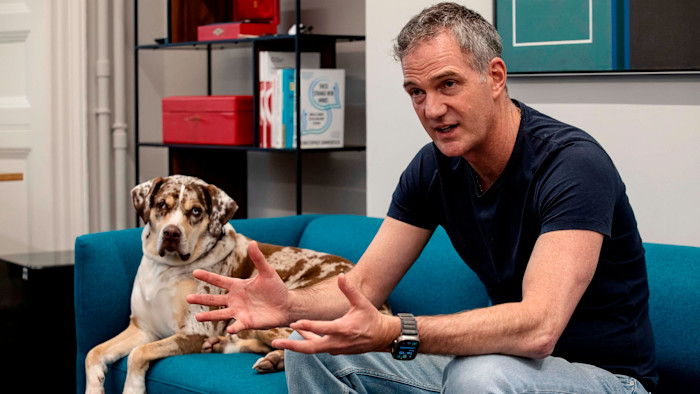
“With the swiftness and the stridency with which the Trump administration acts there is a tendency to think everything is new,” Kyle said, sitting in his Whitehall office alongside Dante, a Catahoula leopard dog. “What you do expect with Donald Trump is the unexpected; this isn’t our first rodeo.”
Trump diluted some of the global tariffs he threatened on “liberation day” last April. Washington could potentially be persuaded to find a compromise to suit all parties, he added.
“Both sides are putting their countries first, if you think of a Venn diagram there is a sizeable chunk in the middle and we have always been able to show respect for the other’s viewpoint,” Kyle said.
At Davos, Kyle and Chancellor Rachel Reeves are likely to face criticism from global business leaders over the UK government’s big tax rises since it took office in July 2024 — as well as its contentious package of pro-worker employment reforms.
Kyle, formerly science and technology secretary, said his overarching priority was achieving faster economic growth. Asked if he hoped ministers would be able to cut taxes by the next parliament, he replied: “It’s what I dream of every night.”

As business secretary Kyle, one of the modernising “Blairites” in the cabinet, has a portfolio that spans the government’s industrial strategy to new post-Brexit trade deals with other countries.
In recent weeks Kyle has been at the forefront of attempts to soften the impact of changes to business rates for hospitality companies, after the sector criticised measures set out in Reeves’ November Budget.
Kyle said it was important “that people know we get it”, adding: “My message to Treasury has always been, ‘let’s get this right, and let’s just listen very carefully’.”
On Tuesday he will announce new proposals to make investigations by the Competition and Markets Authority, the UK’s antitrust regulator, quicker and more proportionate.
A dedicated review to scrap excessive paperwork for farmers is also being launched to cull some of the estimated 150 separate regulations that cost agricultural businesses £590mn a year.
Kyle said he was determined to cut red tape, claiming the recent decision to end the requirement for companies to prepare a director’s report would eventually save UK businesses £230mn a year.
He now plans to take a new task force from the Department for Business and Trade into other Whitehall ministries to cut unnecessary regulations, starting with those covering agritech and health and safety.

Elsewhere, the auto industry has urged ministers to rethink the “zero emission vehicle mandate”, under which a certain proportion of new cars sold in Britain must be battery powered, with that percentage climbing every year until 2035.
Kyle said he was listening to carmakers’ calls to water down the mandate, in line with a recent softening of EU targets, and stressed that he would be a “champion” for the sector.
“I want to create the circumstances [so] that they can flourish . . . I will always be open to what any manufacturing sector in this country says will make the difference between stagnation and decline,” he added.
After the government in effect nationalised British Steel early last year, Kyle faces a strategic dilemma over the future of the lossmaking company, which he admitted was costing taxpayers “a lot of money” to keep afloat.
In the long term, the government wants to shift the business towards green electric arc furnaces, which could secure the future of steel production in Scunthorpe but also risk thousands of job losses and the closure of the UK’s last remaining blast furnace.
Kyle will be part of Starmer’s trade visit to China later this month and is expected to meet Jingye, the official owner of British Steel.
The wider UK steel industry is facing incoming tariffs from the EU that could be even more damaging than Trump’s US tariffs since a much higher proportion of UK steel is sold on the continent. Kyle did not rule out retaliatory tariffs from the UK later this month.
“I will do whatever it takes to protect our domestic steel sector,” he said.
Source link