Unlock the White House Watch newsletter for free
Your guide to what Trump’s second term means for Washington, business and the world
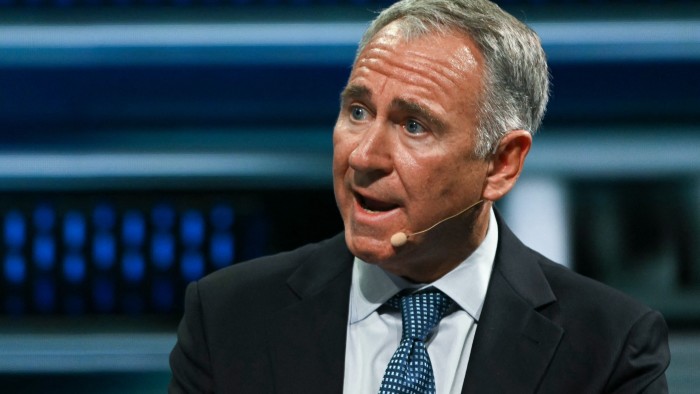
Citadel’s chief executive Ken Griffin has called for Donald Trump to create “distance” between the Federal Reserve and the White House, highlighting investor angst that the US president will pick a close ally to chair the central bank.
“The most important move the president and the incoming Fed chairman can make . . . is to create distance between the White House and the Fed,” the billionaire hedge fund manager said on Tuesday when asked whether Kevin Hassett, a White House economic adviser, should lead the Fed.
Griffin’s comments at an event in Paris come as the race to nominate a Fed chair to replace Jay Powell next May has reached its climax.
Hassett, who has served in both Trump administrations, had emerged as a frontrunner in the race to succeed Powell.
But his odds have fallen in recent days amid signs that the US president is hearing out concerns from senior figures on Wall Street that the White House economist would not be independent enough from Trump and would pander to the president’s wishes to slash interest rates.
Hassett, who has served in both Trump administrations, has said the Fed needs to be able to set interest rates free from political pressure. But he also told CNBC on Tuesday that if the president has a good idea on economic policy, he would pass it on to the central bank’s rate-setting board.
“The president is a seasoned observer of the economy,” Hassett said.
JPMorgan Chase chief Jamie Dimon signalled last week that he believed Kevin Warsh, a former Fed governor who served as a conduit between the US central bank and Wall Street during the 2008 financial crisis, would be a strong pick.
Griffin on Tuesday declined to back any one candidate, saying he did not think “throwing” his choice in the mix “helps to add anything to the argument or decision at hand”.
“The president will hopefully make a decision from the perspective of who will give the global markets and the American investment public and the consumer the greatest peace of mind that we will manage inflation in America,” he said.
Griffin, who founded one of the world’s biggest hedge funds, Citadel, and market makers, Citadel Securities, emerged as a vocal critic of Trump’s tariff policies last year before they were officially put in place in April.
The hedge fund manager has historically been an influential donor to Republican candidates, but stopped short of endorsing Trump for the presidency in last year’s election.
Griffin, who was among the roughly dozen Wall Street chiefs who attended an exclusive dinner at the White House last month, said Trump was very attentive to suggestions from business leaders during a recent meeting on how to tackle persistent affordability issues that have left US voters increasingly frustrated.
“It’s ironic how the tables have turned,” he said, pointing to polling that indicates Democratic prospects have improved dramatically for next year’s midterm elections, adding that Republicans were struggling with the “pro-inflationary” reality of many of their policies.
The warnings on Fed independence come after the Financial Times recently reported that bond investors had voiced their concerns over Hassett securing the nomination to the Treasury department.
Trump interviewed Warsh last Wednesday and said in an interview with the Wall Street Journal that he and Hassett were now neck and neck. Betting markets have since repriced Hassett’s chances, showing the White House economic adviser in a dead heat with Warsh.
The US president claimed both candidates would cut interest rates — which he insists should be as low as 1 per cent, despite inflation still running above the central bank’s 2 per cent goal.
The Fed has cut borrowing costs three times so far this year, with last week’s quarter-point move lowering the benchmark federal funds target range to a three-year low of 3.5 per cent to 3.75 per cent.
Just one voter on the rate-setting Federal Open Market Committee — Fed governor and Trump ally Stephen Miran — backed a half-point cut.
Additional reporting by Malcolm Moore in Paris. Data visualisation by Oliver Roeder in New York
Source link