Unlock the White House Watch newsletter for free
Your guide to what Trump’s second term means for Washington, business and the world
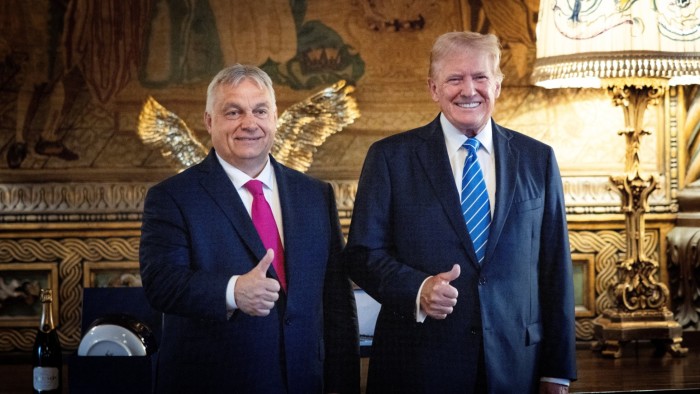
Viktor Orbán is set to meet Donald Trump at the White House on Friday as the Hungarian premier seeks an exemption from US sanctions that would allow his country to continue importing Russian oil.
The Trump administration last month turned up the pressure on Moscow to end its war in Ukraine by adding Russia’s oil majors Lukoil and Rosneft to its sanctions list. The Russian companies have significant operations in Hungary, which has resisted Europe’s push to sever its energy links to Russia after the 2022 full-scale invasion of Ukraine.
Orbán, who is close to both Trump and Russian President Vladimir Putin, has warned that his country faced a severe economic shock if deprived of Russian oil. The premier faces elections in April, and his party is lagging behind an upstart rival who poses the first major challenge to Orbán’s 15-year rule.
EU officials believe Orbán perceives the fuel issue as a significant threat to his re-election. “They are obsessed with it,” a senior EU official said.
When asked last week whether Hungary should be exempt from sanctions, Trump said: “He has asked for an exemption, he’s a friend of mine, Viktor [but] we haven’t granted one.”
The US president last month had appeared sympathetic to the Hungarian leader’s claim that the landlocked country had no alternatives to Russian oil.
“I spoke with the very great leader of Hungary and . . . it’s very hard for them to get oil,” Trump said at the time.
When asked whether he will apply the same pressure as he did on India, which diverted from Russian oil after the US imposed 50 per cent tariffs on Indian imports, Trump explained that “Hungary is sort of stuck because they have one pipeline that’s been there for years and years and years. And they’re inland, they don’t have sea.”
US sanctions against Lukoil and Rosneft are due to kick in on November 21 and threaten to sever the country’s oil imports via the Soviet-era Druzhba pipeline.
Orbán said in a social media post earlier this week that he wanted to “open a new chapter in Hungarian-American relations . . . that embraces energy co-operation”.
The Hungarian premier will be accompanied by Zsolt Hernádi, the chief executive of Hungary’s oil group MOL, which operates refineries in the region and is one of the few remaining importers of Russian oil.
“Energy supply security is a particular challenge for Europe, and this will be one of the key aspects of the meeting” with Trump, Hungarian foreign minister Péter Szijjártó said. “We will create a large energy co-operation package that will help guarantee Hungary’s long term energy security.”
Despite the claims that Hungary has no other alternatives to Druzhba, there is a Croatian-owned pipeline that could supply Hungary and neighbouring countries with seaborne crude.
But MOL has so far resisted the switch, citing higher costs and technical issues with the Croatian pipeline.
Janaf, the pipeline’s operator majority owned by the Croatian government, has dismissed those concerns.
Additional reporting by Alice Hancock in Brussels
Source link