The trendy Hillcrest neighborhood of San Diego, California, was the backdrop for violent acts and hate crimes. Business owners had enough.
The Hillcrest Business Association‘s members in 2024 began paying a third-party service around $400,000 annually for eight hours of unarmed security guard patrol each day. The association plans to add about $150,000 to the budget next year for a second shift.
“It’s about setting a tone in the neighborhood,” said Benjamin Nicholls, the association’s executive director.
Violent crime in the U.S. has plummeted over recent decades, government data shows. But a series of high-profile incidents involving businesses, politicians and community groups has helped catalyze an explosion of spending on protection services in places such as Hillcrest, providing a boon for providers like Allied Universal.
Revenue in the private security sector climbed 17% over the past decade to above $50 billion in 2025, according to Robert H. Perry & Associates. Outsourced services in the U.S. accounted for just over $35 billion, including electronic security systems and manned guarding, the industry broker said.
Some think it’s a sign of the times: As political and cultural tensions hit a boiling point in the U.S., even pockets of American life once considered mundane feel at risk of becoming scenes of violence.
“Who would have thought 10 years ago that you would need to hire private security at a school board meeting or at a town meeting,” said Steve Amitay, executive director of the National Association of Security Companies, an industry group. “We live in a very divisive and inflammatory society right now.”
‘We’re everywhere’
At the heart of the personal protection boom is Allied Universal, a privately held company with operations in more than 100 countries and annual revenue of about $23 billion.
Guards donning Allied Universal’s uniforms oversee lines, operate metal detectors and inspect bags at sporting events, music festivals and office buildings. Allied lists more than 80% of Fortune 500 companies among its clients and has supported globally important events such as this summer’s World Cup.
CEO Steve Jones has publicly shared his ambitions to take the company public. Allied said in a statement to CNBC that “we continue to assess how the company is capitalized” and that its focus is currently on expanding the business and serving customers.
Gregory Winfrey, left, and Benedicto Barnachea, security guards with Allied Universal, prepare to raise the Progress Pride Flag over the Kenneth Hahn Hall of Administration in downtown Los Angeles, California, June 1, 2023.
Gary Coronado | Los Angeles Times | Getty Images
Allied bills itself as the seventh-largest private employer in the world, saying it has roughly 800,000 employees. For comparison, that makes its workforce nearly double the size of Target’s and more than three times as large as Disney’s.
In a given week, Allied said it receives approximately 65,000 applications, interviews around 40,000 candidates and hires about 3,500 people for its North America operations.
“We’re everywhere,” said Glen Kucera, president of Allied Universal’s enhanced protection services division. “I can take you down streets where you’re going to have a tough time taking three steps without tripping over one of our dogs.”
In Lower Manhattan, for example, Allied’s human-and-canine teams are stationed at landmarks like the Staten Island Ferry and the World Trade Center. On a recent weekday morning at the ferry terminal, Kucera’s guards answered passengers’ questions and provided directions. Dogs sniffed bags and bicycles for explosives.
There are other layers to Allied’s protection efforts that may be missed by the naked eye. Employees at the company sometimes joke that they are more than just “mall cops.” Plainclothes workers traverse Manhattan on foot in search of danger. A separate team monitors cameras from a command center, ready to alert staffers on-site if they see a threat.
Allied Universal Security Services patrol SUV parked on city street in San Francisco, California, May 20, 2026.
Smith Collection | Gado | Archive Photos | Getty Images
“Everyone sees the overt security measures,” said Justin Kelley, a vice president at Allied, in an interview with CNBC on the grounds of a canine training facility in Windsor, Connecticut.
“It’s very important to have that physical guard there,” said Kelley, who previously spent more than two decades in the Connecticut State Police. “At the same time, it’s extremely important to have the backstop of the covert security.”
Growing demand
Industry leaders see multiple drivers of demand for private security services, including increased corporate spending and evolving insurance requirements.
About 40% of S&P 500-listed firms provided security services to at least some of their executives in 2025, up from just under 19% in 2019, according to an analysis of corporate disclosures as of early August by Equilar. The median cost ballooned by 178% over that period.
Walmart and other major companies have added executive security for the first time in recent years, Equilar found. In some cases, the spending doesn’t stop when a leader departs: Cracker Barrel said in a regulatory filing in July that the restaurant chain would continue covering protective service expenses for former CEO Julie Masino.
The trade publication Security, which produces an annual report based on self-reported data from security leaders, says the threat of workplace violence has been ranked the top concern facing these leaders since 2021.
Pressure from insurers is a driver of demand, according to Nasco’s Amitay. Firms providing coverage to businesses or events have started viewing a security plan as part of “duty of care” in recent years, he said.
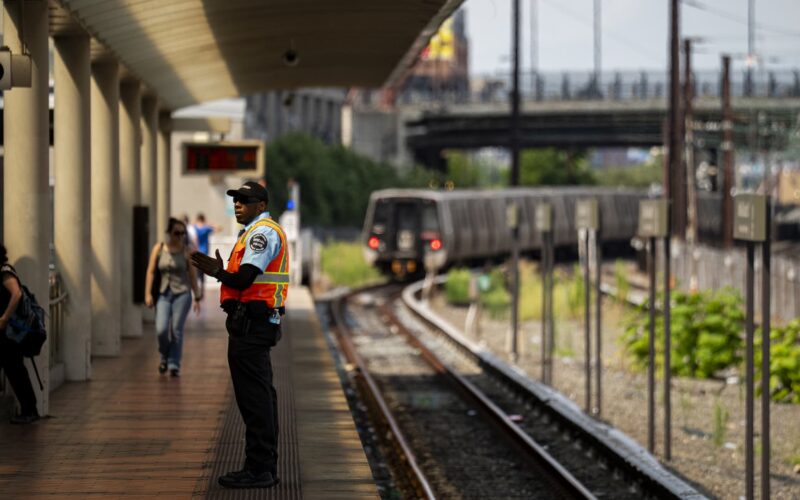
An Allied Universal Special Police officer keeps watch as a Washington Metropolitan Area Transit Authority red line train arrives at the NOMA-Gallaudet U metro station in Washington, July 26, 2026.
Al Drago | Getty Images
Across the U.S., third-party guarding has been brought in to supplement police. In Louisville, Kentucky, city lawmakers passed a measure in July mandating certain businesses open late at night hire private security. The Public Works Department in Santa Fe, New Mexico, budgeted nearly $1 million for contract security at various facilities in its current fiscal year.
“People need to choose their destiny,” said Jonah Nathan, vice president of Ranger Guard, a Texas-based private security provider. “You are your first responder. You have to mitigate things before you can rely on the local law enforcement groups.”
An ‘essential workforce’
Nearly 1.3 million Americans worked as security guards in May 2025, according to the latest Bureau of Labor Statistics estimates. That’s almost double the number of people employed as police and sheriff’s patrol, the report found.
The number of security guards has surged more than 16% between readings taken in 2016 and 2025, the federal data shows. The nationwide police force grew by around 2% over the same period.
The total security guard workforce is expected to stay around flat through 2034, according to a July report from the UC Berkeley Labor Center. Still, the organization found that employers are likely to keep hiring due to high turnover. Annual churn in 2024 hit 89% in the security industry, above the 66% average seen across private-sector payrolls.
Security companies market their jobs as beneficial to social order and largely insulated from artificial intelligence-related automation. But the role also carries safety risks and has below-average compensation.
The mean wage for a security guard was $20.42 per hour, or $42,470 annually, according to the May 2025 Bureau of Labor Statistics report, less than the $38.08-an-hour and $79,200-a-year average income for police and sheriff’s patrol. Across all occupations tracked in the government’s report, the average worker collected $33.54 hourly or $69,770 a year.
A security guard locks the door of the Washington Monument on the National Mall in Washington after it was closed during a record-setting heat wave in the region on July 2, 2026.
Kevin Carter | Getty Images
More than two out of every five security guards don’t have health insurance through their or a family member’s employer, according to the UC Berkeley Labor Center report. Guards are significantly more likely to die while on the clock than the typical employee across industries, the analysis found.
“This is an essential workforce that’s being asked to do more and more,” said Enrique Lopezlira, director of the UC Berkeley Center’s Low-Wage Work Program. “Yet the pay, training and other labor standards of the job have not kept up.”
At the Islamic Center of San Diego, an on-site security guard was among three people killed in a May shooting. Authorities credited the slain guard with slowing down the attack and preventing a larger tragedy.
The San Diego Police Department said its officers were on the scene within minutes of the reported shooting despite staffing shortages. The department said it would review whether low workforce levels impacted its ability to respond to the attack.
Multiple people were killed, including an armed security guard, after two shooters opened fire at the Islamic Center of San Diego, May 18, 2026.
Sandy Huffaker | Los Angeles Times | Getty Images
Perception versus reality
Americans have become increasingly less likely to experience violent victimizations over time, with one gauge tracked by the government plunging 71% from 1994 to 2024. The FBI said that violent crime dropped by an estimated 9% in 2025 alone.
Yet nearly half of Americans see crime as increasing compared with a year prior, according to an Oct. 1-16, 2025, poll of 1,000 U.S. adults from Gallup. The research organization found from a survey of 1,000 adults taken March 2-8 that around two out of every three worried either a “great deal” or “fair amount” about crime and violence. The margin of error for each survey is 4 percentage points.
“The most fundamental fact about public perception of crime and violence in the U.S. is that it is nearly always out of step with reality,” said David Kennedy, director of the National Network for Safe Communities and a professor at the John Jay College of Criminal Justice.
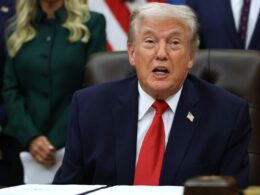
President Donald Trump is assisted by Secret Service personnel after gunfire rang out during a campaign rally at the Butler Farm Show in Butler, Pennsylvania, July 13, 2024.
Brendan Mcdermid | Reuters
While homicide rates have tumbled, Kennedy said they are still higher than in comparable developed countries. He attributed that difference to the relatively loose restrictions on firearms in the U.S.
But Kennedy said there’s a paradox. While more guns can increase the number of fatal incidents, he said, Americans have in many cases turned to them as a way to feel safer.
A great blue heron perches on the boardwalk railing near a security guard at Wakodahatchee Wetlands in Delray Beach, Florida, Jan. 25, 2026.
Ronen Tivony | NurPhoto | Getty Images
A study from Harvard and Northeastern researchers found that more than 11 million Americans became first-time gun owners between 2021 and 2024 — a figure that’s larger than the combined populations of Maryland and Connecticut. Annual non-military gun production in the U.S. roughly tripled in 2023 compared with two decades prior, according to government data.
“It’s very simple fundamentally,” Kennedy said. “The less secure people feel, the more likely they are to take steps to protect themselves and their loved ones.”
Organizations weighing whether to budget for protective services may look to the events at Temple Israel.
In March, an attacker drove into the metro Detroit synagogue, which was filled with children. Its in-house security staff mobilized within seconds, and none of its community members were killed. Leaders at Temple Israel hailed the guards as heroes.
“It is a miracle that they kept everybody as safe as they did,” said Andy Bocknek, the temple’s past president. “Had we not had people who were so committed to the institution, to the people that they see every day, I can’t even imagine what this may have looked like.”
— CNBC’s Charlotte Morabito contributed to this report.
Source link