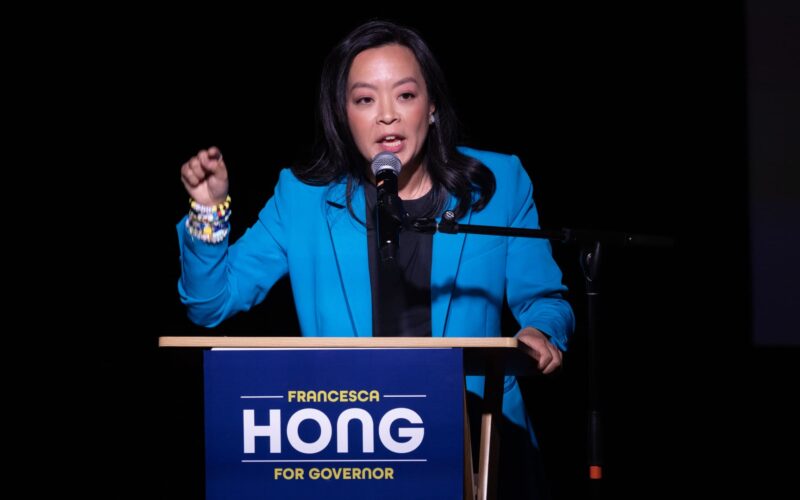
Francesca Hong, a democratic socialist running for Wisconsin governor, this week narrowly lost her primary battle against David Crowley, a Milwaukee County executive, but that doesn’t mean the sheen has rubbed off on the left.
With 82 days before the midterm elections, younger voters are taking up the mantel for Democratic Socialism, according to a new CNBC poll with Generation Lab, a firm that focuses on attitudes and preferences of Americans between the ages of 18 and 34.
According to the CNBC Generation Lab poll, which received responses from 1,088 people earlier this month, 46 percent of Americans between the ages of 18 and 34 now either hold a “favorable” or “very favorable” view of Democratic Socialism. Another 23 percent held “somewhat unfavorable” or “very unfavorable” opinions, per the poll, which had a margin of error of 2.97 percentage points. This year marked the first time the survey was conducted.
“We built something that will change politics forever,” Hong told supporters late Tuesday, ahead of Crowley’s victory. “The work we’ve done will be remembered.”
One of the central themes in the primaries over the last several months has been the rise of democratic socialist candidates in states including New York, New Jersey, Michigan, Pennsylvania and Colorado. A democratic socialist also won a mayoral primary in Washington, D.C. earlier this year.
The cohort’s overall positive attitude on Democratic Socialism goes hand in hand with members’ sentiment on the American economy. When asked “How would you rate the national economy today?” 45% said “bad.” An additional 27% defined the current state of the American economy as “really bad,” while 6% said “couldn’t be worse.” Only 2% of the respondents said the economy “couldn’t be better,” and 3% described it as “great.” Meanwhile, 50% of those who participated in the poll are not optimistic about the future, saying the economy “will get worse,” compared with 22% who said it “will get better.”
Just under half of those polled (45%) said they’re biggest pressure point on their finances was “housing” followed by 39% who cited, “finding a secure and decent paying job.” Also ranking high on the list of pain points was “student loans,” “credit card debt,” and “healthcare.” Due to their financial situations 47% said they have put off vacations, 32% have stopped plans to buy a car, and 30% put off “buying a home.” Perhaps more concerning, 28% have foregone “healthcare” due to financial reasons.
A key part of the economy, and a key part of uncertainty throughout the United States is the growing power of Artificial Intelligence. Less than half (45%) believe AI will have a negative impact on the careers, while 10% believe it will help them. Another 40% believe “the federal government” must set rules for AI, while 36% believe “an independent expert body” should set the rules of the game. Just 8% think AI should just be a free-for-all saying “it shouldn’t be regulated.” A majority, 60%, believe data center construction “must be slowed,” while 15% favor “speeding it up.”
Those polled largely do not trust today’s AI leaders. When asked “who do you trust to act responsibly on AI?” out of 9 key people in the AI industry, Microsoft’s CEO Satya Nadella scored the highest marks with 35% saying they “trust” him, and 65% reporting they “don’t trust” him. Palantir’s CEO Alex Karp scored the worst: 19% “trust” him, while 81% don’t. OpenAI CEO Sam Altman, Meta CEO Mark Zuckerberg, Nvidia CEO Jensen Huang, and SpaceX CEO Elon Musk all scored about the same with about 30% of 18 to 34 year olds trusting them, and 70% saying they don’t trust them.
When asked “What do you do with your money?” 53% said they put it in the bank, while 46% said a top financial priority was “spending on things I enjoy.” More than a third (38%) said they’re “paying off credit card or college debt.”
When it comes to spending, a new phenomenon that has emerged in recent months: prediction markets are taking off with younger audiences, which tracks as prediction market companies are spending big on large online and tv ad campaigns. One third of those polled said they used platforms like Kalshi or Polymarket “once or twice” in the last month. Thirty percent said they used one of the platforms “two to five times” in the last 30 days, while 11% said they’re now using them “more than once per week.”
CNBC and Kalshi have a commercial relationship that includes customer acquisition and a minority investment.
Source link