Unlock the Editor’s Digest for free
Roula Khalaf, Editor of the FT, selects her favourite stories in this weekly newsletter.
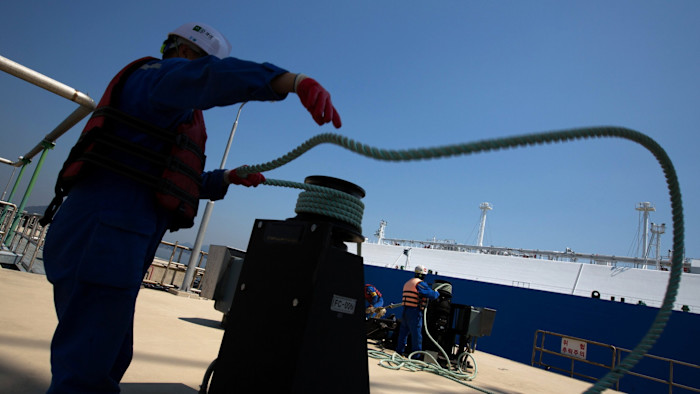
Asian and European buyers are battling to source liquefied natural gas after the war in the Middle East choked off shipments through the Strait of Hormuz, blocking a fifth of global supplies.
In an indication of the intensifying contest for LNG since the US and Israel launched strikes on Iran, a handful of gas carriers have abruptly changed course while sailing to Europe and swung towards Asia instead, according to ship monitoring data analysed by the FT.
Countries across Asia are highly dependent on oil and gas sent through the Strait of Hormuz, a critical waterway where shipping has slowed to a near standstill.
Most of the LNG produced in Qatar and the United Arab Emirates is ordinarily shipped through the strait to Asia, and Asian LNG prices surged almost immediately after war broke out, creating an incentive to divert US gas to the region.
Taiwan, South Korea and Japan are among the countries that need to source LNG to make up for supplies they will not receive from the Gulf, said Massimo Di Odoardo, head of gas and LNG analysis at consultancy Wood Mackenzie.
Taiwan relied on Qatar for more than 30 per cent of its gas consumption in 2025, according to Citigroup, while for South Korea and Japan the figures were 15 per cent and 5 per cent respectively. Asia typically uses more gas than Europe in the hotter summer months because of more air-conditioning use, creating urgency for Asian utilities to secure cargoes.
The vast majority of LNG is sold under long-term contracts rather than on the spot market, but some buyers are able to change the final destination of their purchases and some sellers are willing to break contracts if prices rise high enough.
By Thursday, surging European gas prices and rocketing shipping rates had swung the balance back against diversion of US LNG to Asia, according to data company Spark Commodities.
The decision on where to send gas carriers can depend on the relative levels of the European gas price, Asia’s JKM benchmark for LNG and shipping rates.

For European buyers, the battle with Asia for LNG supplies is eerily familiar to the situation four years ago after Russia slashed pipeline natural gas flows to the continent following Moscow’s full-scale invasion of Ukraine. Competition for spare cargoes then pushed prices to record levels.
On Monday, European gas prices reached as high as €69.50 per megawatt hour, more than double their level before the Iran conflict began. Even so, prices are still far from the €342 per megawatt hour reached in 2022.
JKM gas prices also more than doubled since the start of the war to $24.80 per 1mn British thermal units by Monday, equivalent to €73.10/MWh.
European buyers have learnt from their experience in 2022. “Europe has more weapons at its disposal in this extreme price scenario to try and fight,” said Alex Kerr, a partner at law firm Baker Botts.
Buyers had started putting clauses in contracts to say that suppliers would face much higher penalties if they diverted cargoes for commercial gain, Kerr said.
There is also much more LNG on the market now that is not committed to set destinations, largely because of new projects starting in the US.
While producers such as Qatar impose strict rules on where its LNG can be sent, almost all US exports are allowed to sail wherever buyers want. Several analysts said there had also been an increase in the willingness of some producers to break contracts for financial advantage.
This makes diversions more likely, while the reluctance of some European buyers to sign long-term supply contracts before the outbreak of war this month could prove costly.
Expectations of a global supply glut convinced some European buyers that it would be cheaper to wait until later in the year to sign supply deals.
Wood Mackenzie’s Di Odoardo said the buyers had also held off on LNG purchases because new EU legislation on methane emissions made it unclear whether they could incur penalties in the future.
The risk of prices rising as Europe and Asia fight for available cargoes is increasing every day the Strait of Hormuz stays almost closed.
Gas is more difficult to store and to carry in tankers than oil, making its markets more vulnerable to shortages and price shocks.
“The longer the Strait remains shut, the greater the risk that the shipping disruption turns into a genuine gas shortage, as tankers cannot load and facilities have limited storage,” said consultancy Oxford Economics in a research note.
Additional reporting by Harry Dempsey in Tokyo. Data visualisation by Jana Tauschinski
Source link