Unlock the White House Watch newsletter for free
Your guide to what Trump’s second term means for Washington, business and the world
This is Dirty Harry as foreign policy doctrine. Those nations that fret about due process or the rule of international law are scorned as hand-wringers and pearl-clutchers by Pete Hegseth, America’s defence secretary. And you know who clutches pearls, don’t you? Not men.
Over in Europe where, let’s face it, we are all women, except for Giorgia Meloni or possibly the AfD, there has been quite a bit of unmanly hand-wringing about the attack on Iran. Keir Starmer, Emmanuel Macron and Pedro Sánchez are among the scorned recalcitrants.
This is admittedly uncomfortable for those who care about the legalities because no decent person should shed tears for an Iranian regime that massacres its own citizens and exports terror. Having flouted international law for decades, how can it demand its protection? Indeed, there are some lawyers making the case for this intervention on grounds of Iran’s ongoing threat.
Not that one has to rely on the law to question this war. America appears to lack clear objectives or an endgame. Nor can anyone be sure that President Donald Trump will see it through. The conflict has already spread. Iraq and Afghanistan are lessons for all hawks.
But while people may debate the legal and strategic arguments, what we can’t let stand unchallenged is the insidious accompanying case made by the right and even some democratic leaders: that in the new world order, international law is no longer helpful or applicable.
You can see the premise. Trump’s second term has hastened the return of a global order dictated solely by the interests of the military powers. The entire concept of sovereign nations voluntarily submitting to supranational rules is rejected by Maga Republicans and their international analogues.
The UN is deadlocked and failing, partly because this suits the US. The ethics of conflict are complicated by asymmetric warfare with combatants sheltering among civilian populations and states promoting terror abroad. Gaza saw many western nations choosing sides not laws. It can seem anachronistic and even self-defeating to cling to rules of a game no longer being played. One might expect such observations from Trump (or Russia or China). But it was surprising to find Friedrich Merz, Germany’s chancellor, articulating a similar view earlier this week.
Yet simply sighing in response to the new facts of life will not do. To surrender the fight for (admittedly imperfect) international rules is to accept worse outcomes and more civilian deaths.
If the demise of international law is a fait accompli, why shouldn’t Trump seize Greenland? Are we confident that America will always draw back from upsetting Nato allies? Why protest if Ukraine is carved up by Trump and Vladimir Putin? On what grounds does the US stand up for Taiwan?
This may suit regional hegemons, but the only protection left to middle powers including the UK is to be part of a major player’s gang. That is partly true already but did not always require dumb compliance. Western Europe’s refusal to fight in Vietnam did not weaken US commitment to the continent’s defence.
A second point is that intervention must consider the local population. Other recent US presidents did at least aspire to leave better regimes in place, even if they failed. Trump’s only demand is a leader he can work with.
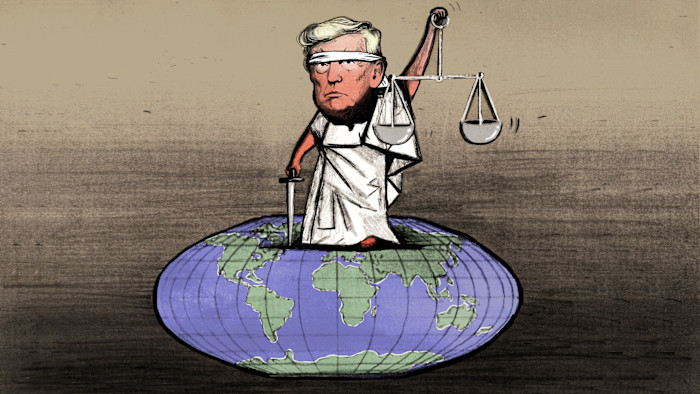
Third, those who are careless of international law are too often careless of the consequences, military, economic, political and human. However much you might rejoice at the fall of the ayatollahs, are you truly comfortable with a world whose moral compass is set by Trump and his cronies? Are these the Clint Eastwoods to whom you wish to delegate the dispensing of global justice?
Finally, as Trump has demonstrated, contempt for international law is often matched at home by a disregard for the rights of one’s own citizens. Leaders who chafe at the courts are invariably the people who want the fewest checks on their personal power.
Many international laws were fashioned by those who witnessed the concentration camps and gulags. Their nations surrendered some sovereignty to bolster the protection of individuals, not in the naive belief that it would end all evil but from the hope that it would restrain it. War leaders standing trial in The Hague, or facing curtailed travel to avoid that fate, demonstrate the potential consequences of atrocities.
This is not something to surrender with a shrug because right now it looks difficult to defend. You stand your ground, however uncomfortable, because the rule of law is a foundational principle of liberal democracy.
Of course there is much in international law that can be reasonably lamented. Its supporters can succumb to a rose-tinted view that ignores how imperfectly it worked before. Too many avoid its reach. Major powers too often break the rules when it suits them. Might will never be removed from the equation. As critics of the European Convention on Human Rights argue, judicial activism has moved treaties beyond their original remit. We can argue, in good faith, over how the law must be updated for the modern world.
What we must never do is accept that its course is run. That is the path to a more corrupt, crueller, more dangerous and dehumanised world. So clutch your pearls, wring your hands and hold the line where you can. The law is never perfect. But it is all we have.
Source link