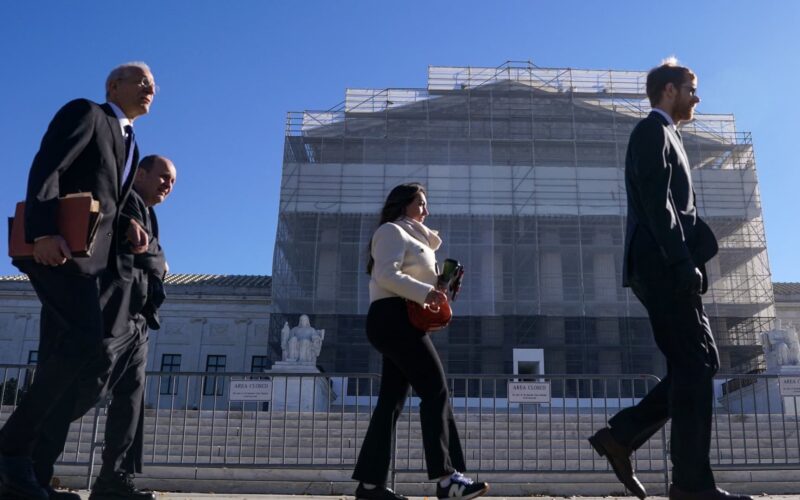
Members of the public walk outside the U.S. Supreme Court to attend oral arguments on U.S. President Donald Trump’s bid to preserve sweeping tariffs after lower courts ruled that Trump overstepped his authority, in Washington, D.C., U.S., Nov. 5, 2025.
Nathan Howard | Reuters
The Yale Budget Lab estimated that consumers’ average cost burden would fall by about half in 2026, to about $600 to $800, if the Supreme Court were to rule against Trump, according to John Ricco, the group’s associate director of policy analysis.
The Tax Policy Center estimated that if the Supreme Court ruled against Trump, taxes on households would fall by $1.4 trillion over 10 years, saving families an average of $1,200 in 2026.
However, the analyses from the Yale Budget Lab and Tax Policy Center assume that the tariffs aren’t replaced. Trump administration officials had previously said they would install new levies, using different legal pathways, to achieve roughly the same outcome.
Trump used the International Emergency Economic Powers Act of 1977 to impose tariffs broadly on U.S. trading partners, pushing up the nation’s tariff rate to its highest since before World War II. It was the first time a president had used the law to levy tariffs.
In a 6-3 decision, the high court ruled that IEEPA doesn’t authorize the president to impose tariffs.
“The Government reads IEEPA to give the President power to unilaterally impose unbounded tariffs and change them at will,” according to the court’s opinion in the case, Learning Resources, Inc. v. Trump.
“That view would represent a transformative expansion of the President’s authority over tariff policy,” according to the opinion. “It is also telling that in IEEPA’s half century of existence, no President has invoked the statute to impose any tariffs, let alone tariffs of this magnitude and scope.”
This is breaking news. Please check back for updates.
Source link