Unlock the Editor’s Digest for free
Roula Khalaf, Editor of the FT, selects her favourite stories in this weekly newsletter.
Outside the oil patch, one of Canada’s hottest exports right now is Heated Rivalry, a TV show about two star hockey players whose passionate relationship is hidden behind the pretence of public enmity. Canada’s Mark Carney seems to be trying an economic version of this with his main trade partner, US President Donald Trump.
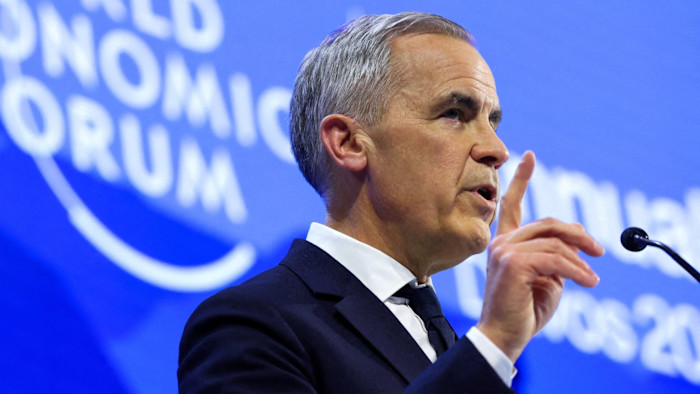
Carney has emerged as a leader of the economic resistance against Trump’s deglobalisation push, mostly because few others dare to speak up. The prime minister has reached for China as a counterweight and called, in a punchy speech to the Davos elites, for middle powers to band together. It’s a risky strategy in two ways.
First, Carney lays Canada open to retaliation from the US, on which his country is hugely reliant. Uncle Sam bought 73 per cent of Canada’s exports in the first 10 months of 2025, according to official data, versus 11 per cent in the opposite direction. Already, a mooted trade “partnership” with China has provoked a threat from the White House of 100 per cent tariffs on all goods shipped to the US.
The second risk is that Carney, in his rush to seal alternative alliances, comes up with poor deals. Lower tariffs on about $4bn of canola oil should please Saskatchewan’s farmers, but slashed levies on 49,000 Chinese electric vehicles are glum news for Ontario’s car assemblers. China has a habit of restricting Canadian canola oil imports when relations get tense. Granting access to a high-value, advanced industry like EVs in return for selling more seed oil seems like a weak deal.
So is Carney, in resisting America First, putting Canada third? Not necessarily. While Canadian imports are smaller for the US in relative terms, they are too important to extinguish, notably to American carmakers and oil refineries. And it is not foolish to show Trump that Canada has options, ahead of the renegotiation of the US-Mexico-Canada continental free trade agreement later this year.
The plucky premier also has the markets behind him. Not only has the Canadian dollar strengthened against its US counterpart during the second Trump era, but Canada’s benchmark TSX Composite index hit a record high on Monday. Despite the friction between the two countries, the TSX has risen 30 per cent in a year, almost twice the performance of the S&P 500.
The main reason is that about half of Canada’s stock market is accounted for by natural resources — where prices reflect global trends, and which the US needs in large quantities — and finance, which is outside the tariff net. Those sectors make up just 15 per cent of the more tech-heavy US equity market, according to data from Morningstar.

In fact the more Trump rages, the better some of Canada’s stocks perform. More than 15 per cent of the index consists of gold miners. The yellow metal, which has soared as investors flee risk, made up over one-third of the TSX’s growth in the past year, according to LSEG data. Nor is it just investors buying: Hong Kong-listed Zijin Gold on Monday offered a 27 per cent premium for Allied Gold, a Canada-listed owner of African gold mines.
The balance is delicate. China, which a public inquiry has concluded attempted to interfere with Canadian elections more than once, is a fickle ally. And Trump is volatile too. Carney’s hope must be that public sparring can coexist with passionate embraces — in real life as well as fiction.
Source link