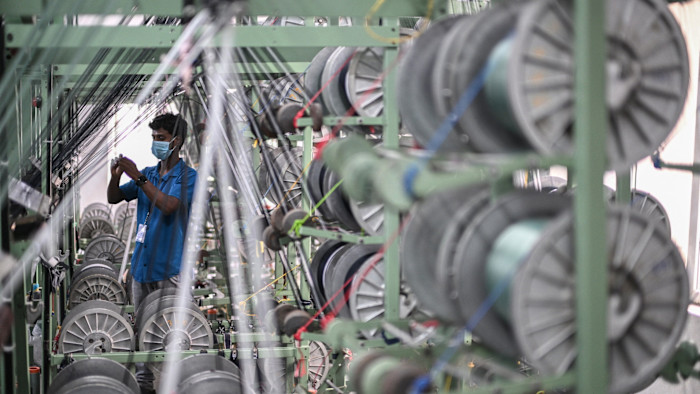
In the half year since US President Donald Trump slapped punitive tariffs on Indian goods, Manish Bhatia’s colleagues at Indo Count Industries, the world’s largest maker of bed linen by capacity, have been busily courting new customers from France to New Zealand.
“We need to diversify,” said Bhatia, chief financial officer at Mumbai-based Indo Count, which relies on US buyers such as Walmart for about 70 per cent of its mainstay bed sheet sales but aims to reduce that to less than half within three years. “You cannot depend on one country.”
It is an effort being mirrored by exporters across India — and one Bhatia hopes will get a boost this week as Indian negotiators race to complete a new trade deal with the EU, a pact that would be the latest in a series sealed by New Delhi since Trump’s tariff offensive in August.
Bhatia said a deal with Brussels would give Indo Count — which has in the past six months been recruiting European sales representatives — a “level playing field” in the bloc. “We’ll get a major boost on that.”
India is still hoping for a lifting or easing of the 50 per cent cumulative tariffs imposed by Trump. But as on-off negotiations with Washington continue to drag, Prime Minister Narendra Modi’s administration has been closing trade agreements with rare haste for a country notorious for stubborn defence of its domestic market.
Last month, India clinched deals with New Zealand and with Oman, seen as a gateway to the Gulf and Africa.
Modi’s government is widely expected to sign the long-awaited pact with the EU during a visit to New Delhi by European Commission president Ursula von der Leyen and European Council president António Costa, who will attend Republic Day events on Monday.
As merchandise shipments to the US slide, the flow of Indian goods is already growing to other destinations such as Hong Kong, Thailand and the UAE. Helped by a thaw in diplomatic relations with Beijing, Indian merchandise exports to China were up more than two-thirds in December compared with the same month in 2024.
The US remains India’s largest trading partner, but exports to other countries rose to $121.4bn between September and December, $4.4bn higher than the same period a year earlier, according to state-owned lender Bank of Baroda.
Madan Sabnavis, Bank of Baroda’s chief economist, said exporters were responding to the US tariffs in different ways, with some focusing on cutting costs to allow them to remain competitive.
“There is also the case of rerouting exports through third countries where the tariffs are lower,” Sabnavis said.

Apex Frozen Foods, a shrimp supplier from eastern India, had been reducing its reliance on the US market even before Trump’s tariffs made its produce too expensive for some buyers, executive director, Karuturi Chowdary told analysts in November.
“Some of our orders had to be moved to some other market,” Chowdary said.
Apex now expects sales to newly accessible markets including the EU, which approved one of its facilities for exports in September, and Australia, which overturned an eight-year ban on Indian shrimp in October. It is also in the process of securing regulatory approval to ship to Russia.
Bhatia at Indo Count said its bed linen business had not passed on the full cost of the tariffs to US customers, helping prevent a collapse in sales. But Indo Count suffered a 9 per cent year-on-year fall in volumes in the quarter ending in September and had taken “some hit on our margin”.
Indo Count, which has contracted designers to help it cater to local tastes in its target countries, expects another boost when London ratifies an India-UK trade pact agreed last year. The company is also pursuing new customers across Australia, the Middle East and last month made its first sales to Japanese retailer Muji.
Modi’s office has been directly pushing overseas diplomatic missions to help exporters diversify, according to officials familiar with the moves.
Trump’s tariffs had given “real impetus” to the effort to find alternatives to the US, an official said. “Initially 10 markets were identified where we should give more thrust. Then it was expanded to 40.”
While India has concluded or is actively negotiating deals with countries that account for about 55 per cent of its total trade, according to Barclays economists, it is not clear how far the gains will offset lost exports to the vast US market.

Priyanka Kishore, founder of research consultancy Asia Decoded, estimated current US levies would reduce India’s GDP by about 0.4 per cent. “The effect could increase significantly over time with cascading effects on employment, consumption and investments,” she said.
Many exporters are watching closely for an early conclusion to India’s trade talks with the US.
Earlier this month, US secretary of commerce Howard Lutnick claimed Modi’s failure to make a call to Trump had derailed a pact when it was close to completion last year. India’s foreign ministry did not directly comment on the allegation, but said Modi had talked with Trump eight times in 2025.
“Lutnick’s recent comments really bring it down to a conversation between the two,” said Kishore. “Which shouldn’t be so difficult, but apparently is really hard to arrange.”
Officials in New Delhi and Washington have suggested negotiations between the two countries have restarted this year in earnest.
Even as they push ahead with efforts to diversify, companies such as Indo Count are hopeful the 50 per cent rate will not last.
“Some sanity should come ultimately,” said Bhatia. “This tariff will go away.”
Source link