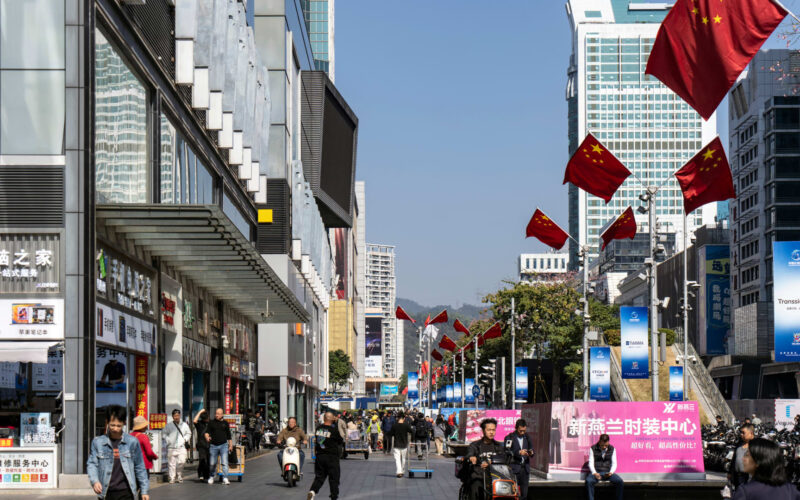
Pedestrians in the Huaqiangbei electronics market area in Shenzhen, China, on Wednesday, Jan. 14, 2026.
Qilai Shen | Bloomberg | Getty Images
China’s economic growth slowed to its weakest pace in nearly three years in the fourth quarter as domestic demand softened, though full-year growth matched Beijing’s target despite growing trade frictions with the U.S. and a prolonged real estate slump.
Gross domestic product grew 4.5% in the October-to-December period, data from the National Statistics Bureau showed Monday. That marked a slowdown from 4.8% in the third quarter and was the weakest reading since the first quarter of 2023, when growth also came in at 4.5%.
Full-year economic output came in at 5%, meeting the official target of around 5%.
Separate December data showed domestic consumption weakened and the investment decline steepened, while manufacturing improved.
Retail sales, a key gauge of consumption, grew 0.9% in December from a year earlier, missing economists’ forecast for 1.2% growth and slowing from 1.3% in the prior month.
Industrial output climbed 5.2% in December, topping expectations for a 5% growth and up from 4.8% in the previous month.
Fixed-asset investment, which includes real estate, contracted 3.8% last year, worse than economists’ forecast for a 3% drop in a Reuters poll.
The urban unemployment rate remained unchanged at 5.1% in December.
The world’s second-largest economy has shown resilience in 2025, largely helped by lower-than-expected tariff rates and exporters’ push to diversify away from the U.S., allowing its policymakers to hold off on launching large-scale stimulus.
China reported a record trade surplus of nearly $1.2 trillion last year, driven by surging exports to non-U.S. markets as manufacturers redirected shipments to avoid higher U.S. tariffs.
The anticipated drag from front-loaded shipments, tighter transshipment controls and currency appreciation has been limited, said Tommy Xie, managing director of OCBC Bank. Xie expects China’s exports to grow around 3% in 2026.
Economists have called for structural economic reforms to shift toward boosting domestic consumption and reducing reliance on exports and investment, warning that the current growth model poses long-term risks.
“Plunging investment and weak household consumption have made the Chinese economy increasingly reliant on exports to power growth, a situation that is untenable for China as well as the world economy,” said Eswar Prasad, a professor of trade policy and economics at Cornell University.
Beijing has sought to rein in excess industrial capacity and curb aggressive price wars. Consumer inflation accelerated to 0.8% in December, the fastest pace in nearly three years, while producer prices dropped 1.9%.
Still, China’s GDP deflator, the broadest measure of prices across goods and services, has remained negative since 2023 and is expected to fall by 0.5% in 2026 in the longest streak on record, according to Larry Hu, chief China economist at Macquarie.
The economy continues to struggle with weak domestic spending amid a prolonged property slump and persistent deflationary strains. New bank loans shrank to a seven-year low of 16.27 trillion yuan ($2.33 trillion) in 2025, underscoring sluggish borrowing demand and piling pressure on the government to provide more stimulus.
The People’s Bank of China last week announced a package of credit-easing measures, including a 25-basis-point cut in rates on various lending tools and increasing quotas for lending programs targeting key sectors such as agriculture, technology and private enterprises.
Economists at Goldman Sachs expect the central bank to cut the reserve requirement ratio by 50 basis points and the policy rate by 10 basis points in the first quarter.
This is breaking news. Please refresh for updates.
Source link