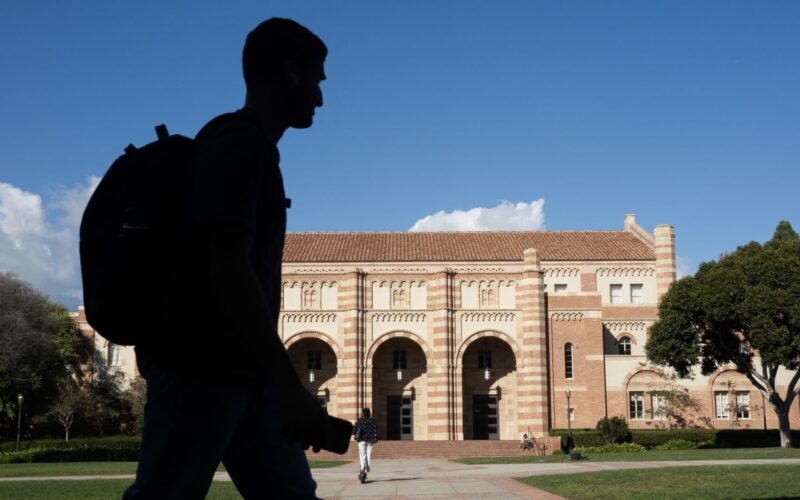
Glorya Kaufman Hall at UCLA on Wednesday, Nov. 19, 2025 in Westwood, CA.
Myung J. Chun | Los Angeles Times | Getty Images
More than 800,000 federal student loan holders remain stuck in a backlog of applications for an affordable repayment plan or debt forgiveness, a new court filing shows.
As of the end of December, 734,221 borrower requests to transfer into an income-driven repayment plan were still pending with the U.S. Department of Education, the agency reported. Another 83,370 borrowers continued to wait for a decision on their Public Service Loan Forgiveness Buyback application.
IDR plans limit a borrower’s monthly bill to a share of their discretionary income and cancel any remaining debt after a certain period, typically 20 years or 25 years.
The buyback option allows borrowers pursuing PSLF to retroactively pay for any months they missed because of a forbearance or deferment, accelerating their timeline to forgiveness. Signed into law in 2007 by President George W. Bush, PSLF offers debt cancellation to those who’ve spent a decade working for certain not-for-profits or the government.
Some borrowers have now been stuck in the backlog for more than a year.
When CNBC spoke with librarian Katy Punch last summer, she had already been waiting for an answer on her PSLF buyback application for eight months. Punch, 38, said Thursday she is “at month 14.”
“I check pretty regularly with the Federal Student Aid chat, and my buyback request is still open and ‘escalated,'” Punch said via email.
“I really worry that I will not receive the forgiveness that was part of my loan contract,” she said.
Many student loan borrowers rely on IDR plans and the loan forgiveness program to be able to afford their monthly payments and to eventually emerge from their debt, consumer advocates say.
Over 42 million Americans hold student loans, and the outstanding debt exceeds $1.6 trillion, according to the Congressional Research Service.
The Education Department did not immediately respond to a request for comment.
Progress on IDR requests, not loan forgiveness
The Trump administration has made progress on the backlog of repayment plan applications, according to its report: Around 802,000 requests were pending in November, and nearly 1.4 million were in July. However, the PSLF buyback pileup is growing. It was at 80, 210 in November and 72,730 in July.
In December, the Education Department reported that it received 258,465 new IDR plan requests and 5,090 buyback applications.
Trump officials agreed to share status updates on their processing of borrowers’ applications in an October settlement with the American Federation of Teachers, a teachers’ union representing some 1.8 million members. The AFT sued the Trump administration last year, accusing officials of denying student loan borrowers their legally required rights.
Many student loan borrowers were forced to apply for a new repayment plan after the Biden administration’s Saving on a Valuable Education, or SAVE, plan was blocked in court. Experts say the backlog of applications has only worsened with the Trump administration’s move in March to terminate thousands of the Education Department’s staffers, including many of the people who helped assist borrowers, consumer advocates say.
“Perhaps the U.S. Department of Education shouldn’t have laid off half their staff if they are incapable of performing their responsibilities,” said higher education expert Mark Kantrowitz.
The challenges accessing income-driven repayment plans and loan forgiveness come amid an especially difficult time for federal student loan borrowers. Around 9 million people are currently in default on their education debt, according to a recent estimate by Protect Borrowers, an advocacy organization. The Trump administration is beginning wage garnishments this month, and experts have warned of the risk of tax refund seizures this spring.
Borrowers are reeling from a weakening labor market and promises of relief that never materialized, experts say. The Biden administration had announced sweeping debt forgiveness and a new repayment plan designed to dramatically reduce monthly payments, but Republican-led legal challenges blocked both of those provisions.
“As millions of student loan borrowers sit on the precipice of default, this administration is using its self-inflicted limited resources to seize borrowers’ wages instead of defending borrowers’ right to affordable payments,” said Persis Yu, deputy executive director and managing counsel at Protect Borrowers.
Source link