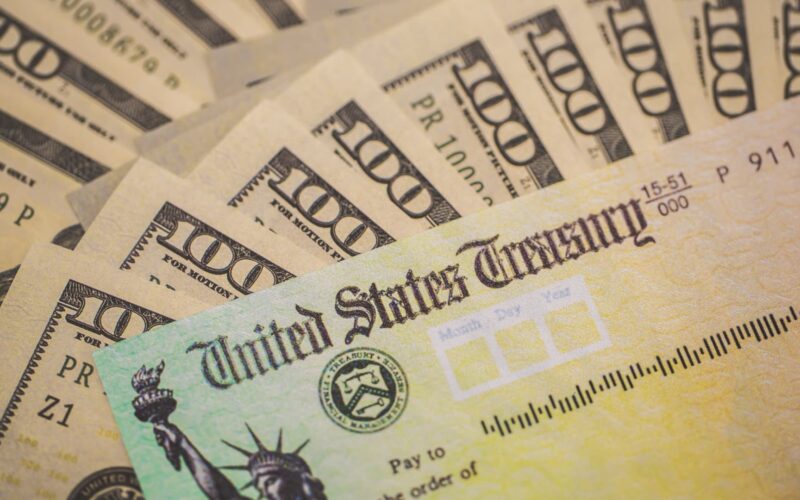
Months after President Donald Trump suggested sending Americans a $2,000 tariff dividend check, many households are waiting to see if that stimulus could come in 2026, despite political and legal obstacles.
“We have taken in, and will soon be receiving, more than 600 Billion Dollars in Tariffs,” Trump wrote in a Truth Social post on Monday.
The president first floated the idea of making direct payments to Americans in the form of a “tariff dividend” in July. Later in the fall, Trump suggested in Oval Office comments and on social media that a rebate check funded with tariff revenue would be likely.
“A dividend of at least $2000 a person (not including high income people!) will be paid to everyone,” he wrote in a post on Truth Social in November.
In an interview on “Face the Nation with Margaret Brennan” last month, National Economic Council Director Kevin Hassett said, “I would expect that in the new year, the president will bring forth a proposal to Congress to make that happen.”
Asked about tariff rebates this week, a White House official told CNBC that “President Trump’s tariffs are raising historic revenue for the federal government, and the Administration is committed to putting that money to good use for the American people.”
The math behind tariff rebate checks
Still, the president’s $600 billion tally far exceeds other estimates. The Bipartisan Policy Center said that U.S. gross tariff revenues in 2025 were $289 billion. According to the Customs and Border Protection agency, the U.S. collected roughly $200 billion in customs duties in 2025.
“Let’s be clear: President Trump’s claim that the U.S. government collected $600 billion from tariffs in 2025 is incorrect,” said Brett House, economics professor at Columbia Business School.
“The White House may decide to issue so-called tariff dividend checks in 2026, but they won’t be fully financed by U.S. tariffs, and they won’t be dividends since Americans paid these tariffs in the first place,” House said. “It’s not a dividend when you give money back to people that they paid earlier.”

“There are costs and benefits of tariffs, but an often-ignored benefit is the leverage in negotiations of trading down ‘Liberation Day’ tariff levels for increased foreign direct investment into the U.S.,” said Tomas Philipson, a professor of public policy studies at the University of Chicago and former acting chair of the White House Council of Economic Advisers. “That benefit dominates any distribution issues of tariff revenue.”
Tariff impact on consumers
A Nov. 17 analysis by the Budget Lab at Yale found that consumers faced an overall average effective tariff rate of 16.8%, the highest since 1935. The increase in prices was expected to cost each household $1,700, on average, in 2025.
The idea of a stimulus check comes at a time when many Americans are feeling particularly strained. Consumers’ views of their current financial situation in December “collapsed” into negative territory for the first time since July 2022, the month after pandemic-era inflation had peaked, according to a report by the Conference Board.
However, a one-time $2,000 per-person tariff rebate for those making less than $100,000 per year would cost $450 billion, the Yale Budget Lab estimated. That’s about twice as much as the total revenue that will be raised by the administration’s tariff hikes in 2026, according to the Yale findings.
First, a ‘warrior dividend’
Trump also announced last month that the government would send a $1,776 “warrior dividend” check to each U.S. service member. Those checks were funded through the Defense Department. Tariff dividend checks, on the other hand, would require congressional approval.
“A potential tariff dividend would be significantly more difficult to implement than the warrior dividend,” said certified financial planner Stephen Kates, a financial analyst at Bankrate. “The warrior dividend was funded through military housing allocations included in the One Big Beautiful Bill. That funding had already been appropriated to the military and was later repurposed to issue checks.”
In the interview on “Face the Nation with Margaret Brennan” last month, Hassett said tariff rebates will “depend on what happens with Congress.”
Last July, Sen. Josh Hawley, R-Mo., introduced the American Worker Rebate Act of 2025, which proposed a rebate check funded with tariff revenue. The Senate referred that bill to the Committee on Finance, where it remains.
“Similar to the stimulus checks issued during and after the Covid pandemic, any broad-based benefit program would require legislation passed by Congress,” Kates also said. “No such legislation currently exists.”
Further, Trump’s tariffs still face legal obstacles that could erase surplus tariff revenue. If the Supreme Court rules that Trump’s new tariffs are unlawful under the International Emergency Economic Powers Act, the court could then say that companies that have paid the duties so far are entitled to refunds. A ruling could be issued as soon as Friday.
Source link