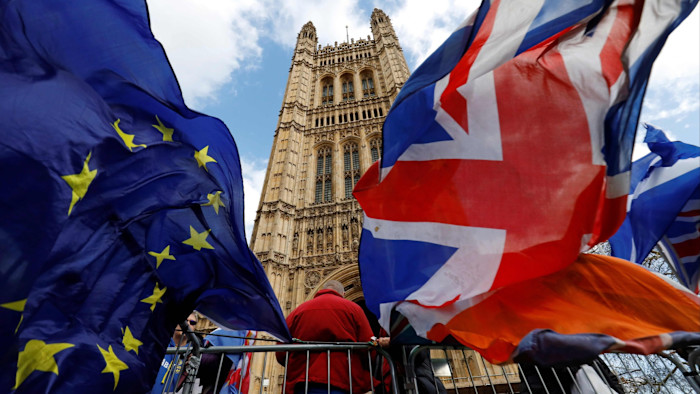
Sir Keir Starmer’s plan to boost Britain’s growth by moving closer to the EU’s single market has been greeted with scepticism in Brussels, with warnings that the initiative is ill-timed and fraught with problems.
The prime minister, under cabinet pressure to form a new customs union with the EU, attempted on Sunday to reassure pro-Europeans in his party that he would go beyond current efforts to “reset” relations with Brussels.
Starmer is set to introduce a new bill, as soon as next month, giving the EU greater oversight of areas such as food standards, animal welfare and pesticide use through so-called “dynamic alignment”.
But Starmer’s allies admit that persuading Brussels to give the UK preferential access to the single market will be difficult.
In Brussels there was a sense of déjà vu amid warnings that — as with former Tory premier Boris Johnson’s failed attempts to “cherry pick” access to the single market — the EU would be highly sceptical of such a move.
One senior EU official said that if Starmer had proposed a more ambitious reset of relations in the wake of his July 2024 election win, there might have been a window of opportunity to discuss different options.
“Brussels is now preoccupied with the Ukraine war, European rearmament and internal negotiations over the next budget cycle,” the official said. “There is no remaining bandwidth at this point, while arguably there might have been back in July 2024.”
Starmer has ruled out forming a customs union, arguing that it would curtail Britain’s freedom to strike trade agreements such as the ones he secured last year with the US and India. He has also ruled out rejoining the single market.
But Wes Streeting, health secretary and a potential leadership rival, has talked up the benefits of a new customs union, as has deputy prime minister David Lammy. The pro-European Liberal Democrats are also increasing pressure on Starmer to go down that route.
To head off this exposed flank, the prime minister on Sunday told the BBC that his preferred option would be to try to align Britain’s rules with those of the single market, in an attempt to gain greater market access.
“I think we should get closer and if it’s in our national interest to have even closer alignment with the single market, then we should consider that,” he said. “If it’s in our interest to do so, we should take that step.”

Downing Street on Monday declined to say which sectors of the economy might benefit from such an alignment, although ministers including chancellor Rachel Reeves have previously said that “established industries” such as pharmaceuticals and cars might be among them.
The government’s new bill will apply to areas such as food and energy where ministers have already been clear that they want closer alignment. One aide said ministers had always been clear that the UK-EU deal on agricultural product checks would require legislation this year.
Two EU diplomats told the Financial Times that while the 27-member bloc wanted better relations with London, it would need to “pay to play” since it could not be allowed special treatment.
Brussels also has its own red lines: single market access requires not just an acceptance of EU rules but also payments into the EU budget and accepting freedom of movement. “The red lines are not a negotiating tactic, they are a political necessity,” said one.
“If we offer something to the British that goes beyond the fundamental rules of the single market it will not be long before [French far right leader] Jordan Bardella or the AfD party in Germany want the same and the single market breaks down.”
The UK’s post-Brexit attempts to improve access to the EU single market have so far been rebuffed by the European Commission, which has applied the same strict rules to Starmer’s Labour government as its Conservative predecessor.
Labour promised to improve access for touring artists to the EU as part of its manifesto, but when it approached the commission after being elected it received the same response Rishi Sunak had received the previous March, when he was Conservative leader.
This was that the visa red tape and other challenges facing UK touring artists were the result of “the UK leaving the single market, including the free movement of persons, and the customs union” and could not be addressed given Labour’s own red lines.

The EU has made similar arguments when the UK has pressed for other concessions, including expanding the mutual recognition of professional qualifications and recognising the validity of UK safety certification bodies for industrial and other goods.
Joël Reland of the UK in a Changing Europe think-tank said: “The challenge is that if you want to go much further and add other sectors, then the EU will demand all the things that the UK doesn’t want to give: payments into the budget and a return to accepting free movement of people.”
Starmer, asked by LBC on Monday whether he was prepared to pay money to Brussels to secure cheaper trade in goods, replied: “Well, nobody is talking about paying more to Brussels.”
Mujtaba Rahman, Europe managing director at Eurasia Group, the risk consultancy, said the idea of the UK trying to seek alignment with the EU on a sector-by-sector basis would be seen as “cherry-picking on steroids” in Brussels.
“The single market is an ecosystem that can’t be picked apart and frictionless access depends on accepting all of its various elements, of which alignment is only one,” he added.
The government is under increasing pressure from trade groups to deepen engagement with the EU, which continues to take nearly half of all UK trade.
The Labour leadership has trumpeted the value of its recent deals with India and the US, but government assessments have found the value of those deals to be negligible when set against the costs of Brexit.
The independent Office for Budget Responsibility said at November’s Budget that Starmer’s “reset” would lead to just a 0.24 per cent long-term increase to GDP, only a small fraction of the 4 per cent hit to GDP that economists estimate Brexit has caused.
One senior UK minister admitted the current policy of trying to increase trade in food and energy, coupled with efforts to improve mobility for young people and professionals such as architects, was “by far the best — and likely only realistic — place to be”.
The minister added: “The pro-EU side always underestimates that the EU might not want to play ball.”
But Stella Creasy, chair of the Labour Movement for Europe, said that “greater access to the single market is the gateway to growth”, adding that Starmer needed to be more ambitious.
“The government should be bold in making the case for the next steps in our reset with Europe and making sure those steps are big enough to count,” she said.
Source link