Good morning, and welcome back. We hope you had a great break.
Today, I assess Europe’s mealy-mouthed responses to US President Donald Trump’s violation of Venezuelan sovereignty, and Laura reports on France’s plan to impose new trade restrictions to protect its farmers.
Rule of war
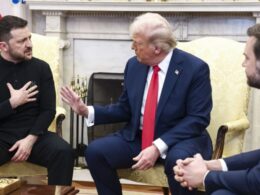
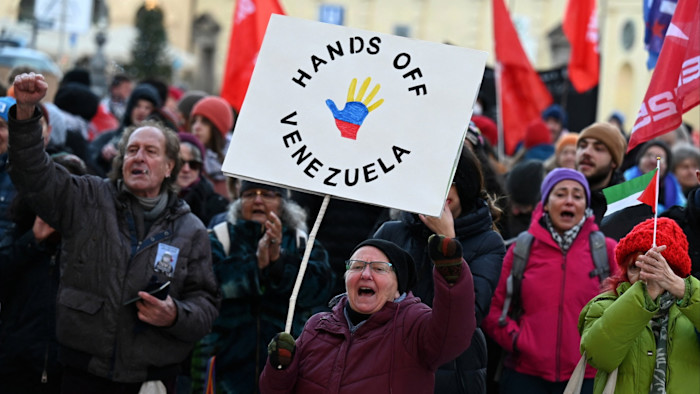
Just how far is Europe willing to excuse Donald Trump’s behaviour for the sake of appeasement? In some of the continent’s capitals, many think his smash-and-grab attack on Venezuela should be a turning point.
Context: US special forces backed by bombers, fighter jets and helicopters attacked Caracas early on Saturday and captured President Nicolás Maduro, who is now in a New York jail. The regime change operation will mean the US will “run” the country indefinitely, Trump has said.
The operation, which national leaders, politicians and law experts claim breached international law, poses enormous legal and moral questions for EU governments.
For almost four years, the EU has justified sending almost $200bn worth of weapons and financial aid to Ukraine in the name of defending Kyiv’s sovereignty and territorial integrity.
A statement issued last night by the EU’s chief diplomat Kaja Kallas and endorsed by all member states except Hungary did not state that those two values had been breached in Venezuela.
The closest it came to condemnation was stating that “the principles of international law and the UN Charter must be upheld”, noting members of the UN Security Council have a “particular responsibility” to do so.
“It somehow manages to not even hint at the insanity of the intention of the US to ‘run’ another country whose president they have just kidnapped,” said one EU official about the statement.
Other EU statements called for “de-escalation”, condemned Maduro, and deployed that classic cop-out of “following the situation closely”.
Spain’s Prime Minister Pedro Sánchez was the exception, referring to a “violation of international law in Venezuela, an act that we strongly condemn”.
Fearful that Trump could ban supplies of arms or intelligence to Ukraine or undermine US security guarantees to Europe, EU leaders have bent over backwards to avoid upsetting him, choosing deference over defending their principles even when he directly menaces the continent with trade tariffs or threats against their digital rules.
While Maduro was not recognised as Venezuela’s legitimate leader by almost all western capitals, analysts warned that not condemning the attack of another country and the kidnapping of its leader risked encouraging similar moves by other states, confident that the US had read the funeral rites of the rules-based international order.
The biggest danger to Europe could be a sequel mission from an emboldened Trump. This weekend, he repeated his assertion that the US “needs” Greenland, the vast Arctic island that is part of Denmark.
Hours after the Venezuela raid was announced, Katie Miller, a prominent Trump supporter and wife of his deputy chief of staff Stephen Miller, published a map of Greenland overlaid with the US flag, with the caption: “SOON”.
“It makes absolutely no sense to talk about the need for the US to take over Greenland . . . I would therefore strongly urge the US to stop threats against a historically close ally,” Danish Prime Minister Mette Frederiksen said last night.
Chart du jour: Keep out
With many western countries shutting their doors, the economic impact of a historic turn against immigration is likely to grow in 2026, writes Ruchir Sharma in his top 10 predictions for the year.
Avocados out
France, the country most critical of the EU’s trade deal with Mercosur, is taking matters into its own hands with measures it says will protect farmers, writes Laura Dubois.
Context: Paris argues that the Mercosur deal threatens French farmers who could not compete with cheap imports from Argentina, Brazil, Paraguay and Uruguay. Amid criticism from France, Italy and others, the agreement has been repeatedly delayed.
The European Commission is in last-ditch talks to get critical capitals on board before the signing, planned for January 12 in Paraguay.
Before Christmas, the commission said it would forbid imports of products grown with pesticides banned in the EU, subject to impact assessments.
But France has said it wants to push ahead with the measure more quickly. “A decree will be issued in the coming days . . . to suspend the importation of products containing residues of substances banned in Europe,” French Prime Minister Sébastien Lecornu wrote yesterday on X.
“Avocados, mangoes, guavas, citrus fruits, grapes, and apples from South America and elsewhere will no longer be allowed to enter the country,” Lecornu added.
“It is now up to the European Commission to generalise this,” agriculture minister Annie Genevard wrote in a separate post.
The measure, which likely needs to be approved by the commission in order not to breach EU law, comes as farmers in France have warned they could increase protests against the deal over the next week.
The commission declined to comment.
Now read these
-
Laying the groundwork: The heads of France’s far-right Rassemblement National are courting business leaders ahead of a possible rise to power.
-
Used against EU: Chinese buyers are abusing the EU’s recycling system to snap up aluminium scrap, smelt it and export it back to Europe as new metal.
-
‘Down to the wire’: The ECB’s digital euro faces a decisive vote in 2026 but parties in the European parliament are divided over the project.
Are you enjoying Europe Express? Sign up here to have it delivered straight to your inbox every workday at 7am CET and on Saturdays at noon CET. Do tell us what you think, we love to hear from you: europe.express@ft.com. Keep up with the latest European stories @FT Europe