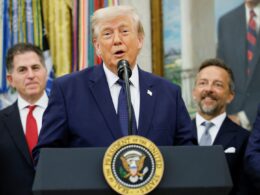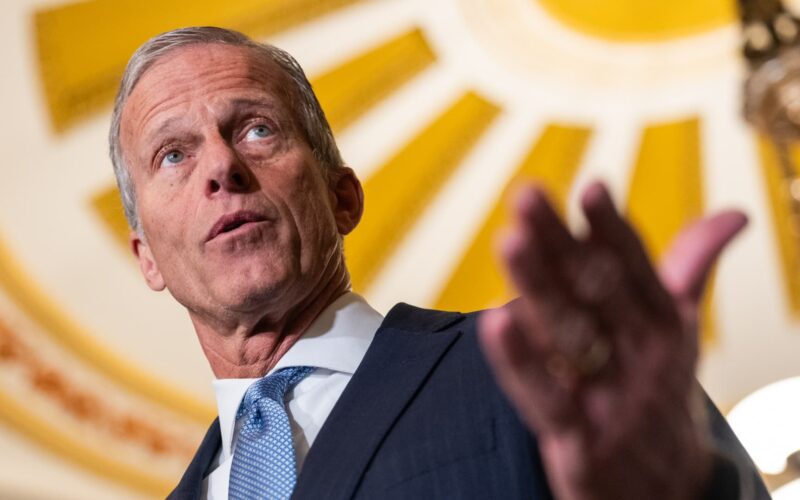
Senate Majority Leader John Thune, a Republican from South Dakota, during a news conference following the weekly Senate Republican policy luncheon at the US Capitol in Washington, DC, US, on Wednesday, Nov. 19, 2025.
Eric Lee | Bloomberg | Getty Images
As lawmakers’ debate over Affordable Care Act enhanced premium subsidies continues, Republicans have pointed to reports of fraud in the health insurance marketplace as a reason they shouldn’t extend the tax break.
GOP lawmakers cited a Dec. 3 report from the U.S. Government Accountability Office, a nonpartisan congressional watchdog, on fraud tied to ACA subsidies.
Democrats’ proposal to extend the ACA enhanced credits “is rampant — and I say rampant — with fraud and abuse,” Senate Majority Leader John Thune, R-SD, said on the Senate floor Thursday.
Some health policy experts say the scope of the fraud isn’t as severe as lawmakers have suggested, and that it’d be better to improve Obamacare’s security measures rather than cut enhanced subsidies altogether.
“It really is trivial, the scope of fraud,” said Michael Gusmano, a professor of health policy at Lehigh University. “It’s just a scare tactic to justify the reduction of the federal government’s role in subsidizing health insurance,” he said.
He pointed to one finding as an example: In 2023, more than 58,000 Social Security numbers of deceased people also received a premium subsidy, according to the GAO. That amounted to just 0.4% of all Social Security numbers that received a premium tax credit that year, the GAO found.
Republicans cite ACA fraud as impediment
Senate Democrats proposed to extend enhanced ACA subsidies — due to expire at year’s end — for three more years. Those subsidies lower insurance premiums for ACA enrollees.
About 22 million people, or 92% of ACA enrollees, receive the subsidies, according to KFF, a nonpartisan health policy research group. KFF estimates recipients’ insurance premiums will more than double in 2026 without them, on average.
Republicans proposed a plan that would allow the enhanced ACA subsidies to expire. They would instead issue payments of up to $1,500 to consumers with health savings accounts.
Both measures failed in the Senate on Thursday.
House Speaker Mike Johnson, R-LA, said Tuesday that he won’t call a vote to extend enhanced ACA subsidies, making it a near guarantee that they will expire as scheduled.
Republican lawmakers cited fraud as a key reason not to extend the subsidies.
“We will never have a competitive marketplace when that marketplace is riddled with fraud,” Sen. Bill Hagerty, R-TN, said Thursday.
The GAO report outlined various channels of fraud involving ACA subsidies available through the federal marketplace, which is used by about 30 states. The rest operate their own marketplaces.
“When you look at [the] facts of this report, the depth of the negligence becomes undeniable,” Rep. Jefferson Van Drew, R-NJ, chairman of the House Judiciary Subcommittee on Oversight, said during a hearing Wednesday on ACA subsidy fraud.
The report comes as President Donald Trump and Republicans have recently lashed out over fraud in other benefit programs.
For example, President Trump has recently said he doesn’t want Somali immigrants in the U.S., calling Minnesota, where there is a large Somali population, “a hub of fraudulent money laundering activity.” Many of the alleged perpetrators of a series of fraud scandals tied to social safety net programs in that state, estimated to potentially cost more than $1 billion, are Somalis.
The late Sen. John McCain (R-AZ) leaves the Senate Chamber after a vote on a stripped-down, or ‘Skinny Repeal,’ version of Obamacare reform on July 28, 2017 in Washington, DC. McCain was one of three Republican Senators to vote against the measure.
Zach Gibson | Getty Images News | Getty Images
Republicans have also tried to dismantle the ACA since its early days. This year, a multibillion-dollar GOP package of tax cuts known as the “big beautiful bill” made several administrative tweaks to the ACA; more than 3 million people are expected to lose coverage over the next decade as a result.
In 2017, a Republican measure to repeal and replace the ACA failed after a dramatic “no” vote from three GOP defectors, including the late Senator John McCain of Arizona.
GAO report found fake people got ACA subsidies
Through covert testing, the GAO submitted fictitious applications via the federal ACA marketplace in 2024 and 2025.
The federal marketplace approved all four fake applications the GAO submitted in 2024, collectively amounting to $2,350 per month in premium subsidies that were paid directly to insurers, the report said.
In 2025, the GAO submitted another 20 fictitious applications; 18 of them were approved and still active as of September 2025, the report said. Their combined premium subsidies paid to insurers were more than $10,000 per month, it said.
The findings suggest “enrollment control weaknesses,” the GAO wrote.
However, the findings can’t be generalized to the universe of ACA enrollees and are consistent with the results of similar testing conducted in 2014 through 2016, according to the GAO.

Subsidies have been available since 2014, in the early days of the Affordable Care Act, also known as Obamacare. The subsidies, called premium tax credits, were enhanced in 2021, making the credit more valuable and available to more households.
“My main takeaway from the report is that fraud has been a consistent problem for the federal Marketplace, as we might expect for any federal program where substantial subsidy dollars are involved,” Kaye Pestaina, director of KFF’s program on patient and consumer protection, wrote in an e-mail.
“It’s not small, but the GAO report does not indicate that this is an outlier when compared to fraud in other federal programs,” she wrote.
Fraud tied to Social Security numbers
In 2023, more than 58,000 Social Security numbers of deceased people also received a premium tax credit, according to the GAO.
It’s unclear how many of those people may have legitimately qualified for the subsidies and then subsequently died, Gusmano said.
Additionally, there were instances of Social Security numbers being used more than once to apply for benefits. The GAO found more than 29,000 Social Security numbers with more than 365 days of insurance coverage with ACA subsidies in 2023, and about 66,000 in 2024.
Speaker of the House Mike Johnson (R-LA) discusses rising health insurance premiums as U.S. House Majority Leader Steve Scalise (R-LA) (L) and House Majority Whip Tom Emmer (R-MN) look on during a press conference in the U.S. Capitol Building on Dec. 10, 2025 in Washington, DC.
Heather Diehl | Getty Images
However, the raw numbers are misleading, said Gusmano of Lehigh University. They mask that the numbers represent a small share of overall subsidy recipients, he said.
For example, the data about dead individuals amounted to 0.4% of all Social Security numbers that received a premium tax credit in 2023, GAO found. Similarly, cases of multiple uses of Social Security numbers amounted to 0.2% of all numbers in 2023 and about 0.4% in 2024, GAO found.
“I don’t think they’ve uncovered massive fraud and abuse,” said Gusmano. “Some things look immediately like scary numbers if you ignore the denominator.”
Even for those who think the fraud is substantial, a reasonable response would be to make reforms to the system to reduce waste rather than allow the enhanced subsidies to expire, Gusmano said.
“The idea that you get down to zero in terms of any kind of problem with any system, if we applied that to any program, public or private, they’d all have to shut down,” he said. “That’s a deeply problematic standard.”
Senate Minority Leader Chuck Schumer, a Democrat from New York, during a news conference following the weekly Senate Democrat policy luncheon at the US Capitol in Washington, DC, on Dec. 2, 2025. Chances are increasing that Obamacare subsidies will expire at the end of the month and trigger a spike in health insurance premiums as a deadlock in Congress deepens on the issue.
Graeme Sloan/Bloomberg via Getty Images
The negative financial consequences for households and impacts on public health of not extending the subsidies far outweigh the losses from fraud, experts said.
The average subsidy recipient would see their out-of-pocket premium payments increase to about $1,900 in 2026 from nearly $900 in 2025 if enhanced subsidies disappear, according to KFF. Many households would lose assistance altogether. About 4.8 million people are expected to drop their health coverage next year if enhanced subsidies expire, according to the Urban Institute.
I don’t think they’ve uncovered massive fraud and abuse.
Michael Gusmano
professor of health policy at Lehigh University
Nick Fabrizio, a health policy expert and associate teaching professor at Cornell University’s Jeb E. Brooks School of Public Policy, said the U.S. should extend the subsidies for 2026.
However, unlike the Democrats’ proposal, an extension should be tied to reforms to throttle back the scope of fraud in the federal marketplace and to put a lid on ballooning costs in the broader healthcare system, he said.
“We’re in one of those situations where we have to extend the subsidies,” he said. “We have no other choice. But we have to stabilize the system. … We have to meet somewhere in the middle.”
ACA fraud risk increases as program grows
A large governmental program is bound to have some level of fraud or corruption, Fabrizio said.
The GAO report notes that fraud risks are likely to increase as the ACA subsidies grow, and that the Centers for Medicare & Medicaid Services hasn’t updated its fraud risk assessment since 2018, before enhanced ACA subsidies became available.
For example, CMS estimated that the premium tax credit totaled about $124 billion in 2024, more than double the $53 billion in 2018, according to the report.
That growth may warrant additional fraud controls, it said.

“There is fraud in every insurance program that I’ve ever studied,” said Gerard Anderson, a professor of health policy and management at the Johns Hopkins Bloomberg School of Public Health. “If there’s money to be made doing some level of fraud, people will take advantage of it.”
Anderson said he thinks the government should tweak some parameters of the ACA subsidy system.
For example, enhanced subsidies allow certain low-income ACA enrollees to get health insurance with $0 premiums. CMS has identified such zero-premium plans as a potential pathway to fraud; insurance brokers can enroll people in plans without their knowledge and collect a commission from insurers in the process.
Implementing even a small premium would reduce such fraud, Anderson said.
“I think you should always tweak the parameters of the system,” he said. “It’s appropriate to make revisions because you can’t anticipate everything that’s going to happen.”
Source link