Stay informed with free updates
Simply sign up to the Global Economy myFT Digest — delivered directly to your inbox.
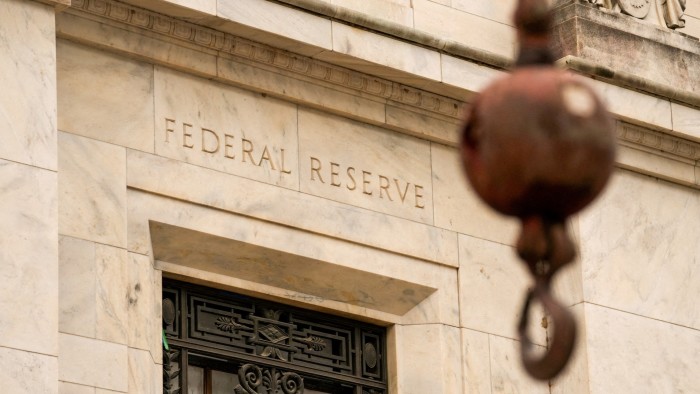
The Federal Reserve’s minutes from its October meeting will be published on Wednesday, just as investors are growing increasingly uncertain about the path of US interest rates.
The Fed lowered its benchmark rate to a range of 3.75 per cent to 4 per cent last month. But investors who were hoping that the central bank’s chair Jay Powell might hint at another cut in December were left disappointed.
A quarter-point cut in December had been fully priced in leading up to October’s meeting. Powell’s statement that a further reduction of the policy rate at the end of the year “is not a foregone conclusion” quickly recalibrated the market’s expectations.
Boston Fed president Susan Collins this week cast further doubt on a reduction next month, arguing that there was “a relatively high bar for additional easing in the near term”.
The central bank’s uncertainty was caused in large part by the US government shutdown, which was brought to an end after 43 days on Wednesday. Key data on the labour market and inflation went unpublished while government services were halted, leaving investors in the dark about the health of the world’s biggest economy.
An absence of data and the delayed release of other closely watched measures of the state of the jobs market mean “the Fed may have an incomplete picture” of the economy during its December meeting, said Morgan Stanley analysts in a note to clients.
Gaps in that picture may soon be partially filled. Kevin Hassett, director of the National Economic Council, told Fox News on Thursday that some of the missing jobs data would be released. Analysts at Goldman Sachs said they expected the Bureau of Labor Statistics to issue a release schedule in the coming week. George Steer
Has UK inflation peaked?
Investors will be closely watching UK inflation data next week for confirmation that price growth peaked in September, as forecast by the Bank of England.
Economists expect official data due on Wednesday to show annual inflation easing to 3.6 per cent in October, from 3.8 per cent in the previous month, in line with the BoE’s forecasts.
Philip Shaw, economist at investment bank Investec, expects a lower rate at 3.5 per cent, citing a smaller rise in the gas and electricity price cap than last year, weaker food inflation and downward effects from air fares.
“While the Monetary Policy Committee is unlikely to be influenced excessively by one data point, a lower out-turn would tend to support our view that the committee will lower the bank rate once again by 25 basis points next month,” he said.
The BoE will announce its policy decision on December 18, after the Budget on November 26, a key event that is likely to influence rate-setters. The government’s U-turn on income tax rises unsettled markets at the end of this week.
More crucial data will follow on Friday, on public finances, retail sales and business activity as measured by purchasing manager indices.
Investec forecasts a slowdown in retail sales growth to 0.1 per cent in October from 0.5 per cent in September, with the flash composite PMI — covering services and manufacturing — also weakening to 51.3 in November from 52.2 in October.
“We doubt consumer momentum continued at this remarkable pace into October, but given the strong trend in recent months, we are hesitant to pencil in a fall in sales,” said Shaw.
Investec expects the gap in public borrowing to continue to overshoot the OBR’s forecasts in October, providing further bad news for the chancellor just ahead of her Budget. Valentina Romei
Can the Eurozone economy stage a renaissance?
On Friday, the HCOB flash Eurozone PMI will give a sense of private sector activity across the region in November.
Economists expect the Composite index to stay at 52.5 points, unchanged from October, when the indicator of business activity in the region rose to its highest reading in two and a half years, well above the 50-point mark that separates expansion from contraction.
Services activity is forecast to continue its strong expansion, matching October’s 53 points, while activity in manufacturing — a sector affected by tariffs — is expected to grow slightly to 50.2 points, from 50 points in September.
“People are looking for a renaissance in European growth, but there is not much evidence of that,” said Tomasz Wieladek, European economist at T Rowe Price, pointing to the forecast that the services sector will replicate October’s strong performance.
“If it improves again and is such a big improvement again, that will have a really good impact” on European markets, while a drop could suggest “that Europe is stagnating”. Rachel Rees
Source link