Unlock the White House Watch newsletter for free
Your guide to what Trump’s second term means for Washington, business and the world
The writer is an FT contributing editor and writes the Chartbook newsletter
At critical moments in history, technological change can produce not just economic growth. It can consolidate or disrupt political regimes.
In the wake of the first world war, Fordism was not only a production line, it offered the vision of a new culture of mass affluence.
In the 1970s and 1980s, the revolution in microelectronics and computing rang in the end of the Soviet bloc.
In 2008, the excitement generated by the new generation of smartphones and the advent of social media did much to offset the toxic shock of the financial crisis. After all, if capitalism gave us the iPhone and Facebook, it could not be all bad.
But such narratives can easily turn. A conveyor belt becomes a metaphor for alienation. Digital platforms become drivers of polarisation and civil war.
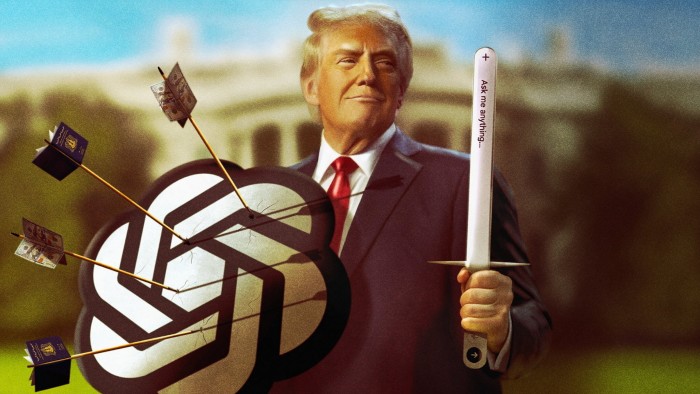
In our present moment, the hyperscaling of AI is taking off just as Donald Trump has launched into his second, radical term in office.
In the short term, commentators agree that this coincidence is helping to shield the US president from the pushback his more dysfunctional policies might otherwise be expected to provoke, notably from powerful business elites.
Corporate leadership and investors can distract themselves from the breakdown of regular governance by the big news on the tech front.
As far as the US economy is concerned, the “two bads” of tariffs and the crackdown on immigration are offset by the “one big positive” of the AI boom. The elite are lulled with a combination of tax cuts and stock market gains.
But if you look beneath the hood, the sense of stability engendered by the balancing of Maga with AI is distinctly precarious.
If Trump’s disinhibited administration is the product of America’s social and political tensions, there is nothing in the coincidence of Maga and AI to ease or alleviate any of those stresses.
Start with the pervasive sense of national decline — the ultimate source of US elite anxiety. The answer of the Biden administration was to keep Big Tech under lock and key. Restrict the most high-tech chip exports. But that was unpopular with the chipmakers and tended to stimulate creative evasion in China. The Trump administration seems to hope that the US can dominate through the proliferation of its technology. But that tends to spread the shock and further encourages multi-polarity. Then Nvidia’s Jensen Huang tells you that China is going to win anyway and where do you go from there?
At home, the professed goal of the Trump administration, like that of Joe Biden, is to revive the US industrial base and restore the stability of working-class and middle-class livelihoods. But how does that square with encouraging Silicon Valley to bet hundreds of billions of dollars on replacing a large part of the white collar workforce with algorithms?
Those algorithms are a radical cultural technology. Our best hope is that they will make good the dreams of endogenous growth theory and unleash a spectacular acceleration in the productivity of R&D, thus accelerating scientifically led economic and cultural transformation. But isn’t there a deep irony in an administration as obscurantist and post-truth as Trump 2.0 presiding over the dawn of artificial general intelligence? Neither JD Vance’s neo-Catholicism nor the bizarre sermons of Peter Thiel can paper over the incoherence of historical and philosophical vision.
And it may of course be the case that AI has been overestimated. That we shouldn’t believe the hype. But what happens then? Does the bubble burst? As Gita Gopinath pointed out after leaving the IMF, a dotcom-sized adjustment to US equity markets would today inflict losses of $20tn on US investors and $15tn on the rest of the world. That is 70 per cent of US GDP and 20 per cent of the rest of the world’s. More than enough to spark a severe recession. How do we imagine that the Trump administration, with a gaping deficit, a politicised Fed and a deadlocked Congress, would react to that?
Those clinging to the idea that America might one day return to its senses are, it would seem, hoping for a goldilocks crash: big but not too big — enough to dispel the AI hype and the intoxication of Trump’s first year but not enough to provoke a constitutional crisis even worse than the one we are already living through.
To paraphrase the punchline of a lurid AI potboiler published in September, “I wish I were exaggerating”. But if a return to American normality is what you are hoping for, it is not obvious how you get there from here.
Source link